• Skip to main content
  • Why Plura
    • Our Team
    • Videos
    • 15th Anniv.
    • Our History
    • Case Studies
    • Distributors
  • Products
    • At a Glance
    • X Processing
    • I.M.D.P.
    • Monitors
    • Timing
    • Calibration
    • Viewfinders
  • Support +
    • Downloads
    • Virtual Mtg.
    • RMA Request
  • News + Events
    • News
    • Events
  • Contact
  • Why Plura
    • Our Team
    • Videos
    • 15th Anniv.
    • Our History
    • Case Studies
    • Distributors
  • Products
    • At a Glance
    • X Processing
    • I.M.D.P.
    • Monitors
    • Timing
    • Calibration
    • Viewfinders
  • Support +
    • Downloads
    • Virtual Mtg.
    • RMA Request
  • News + Events
    • News
    • Events
  • Contact
Signal Processing
I.M.D.P.
Monitors
Timing
Calibration
Viewfinders
Home  //  Signal Processing  //  Avenue  //  Avenue 9670 Audio Automatic Gain and Loudness Control and 9690 Audio Compliance and Monitoring Software
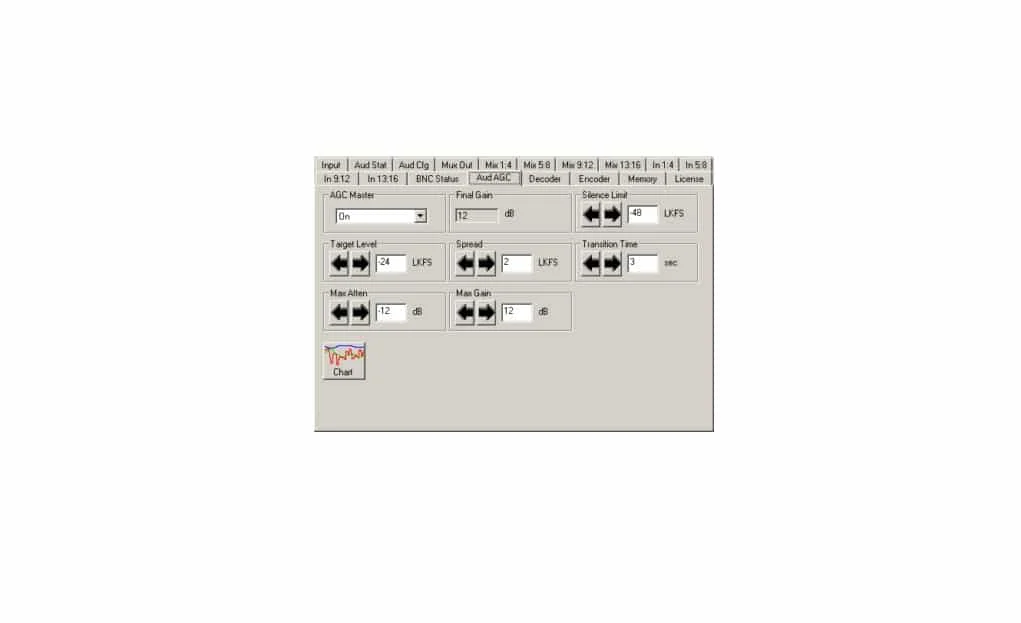
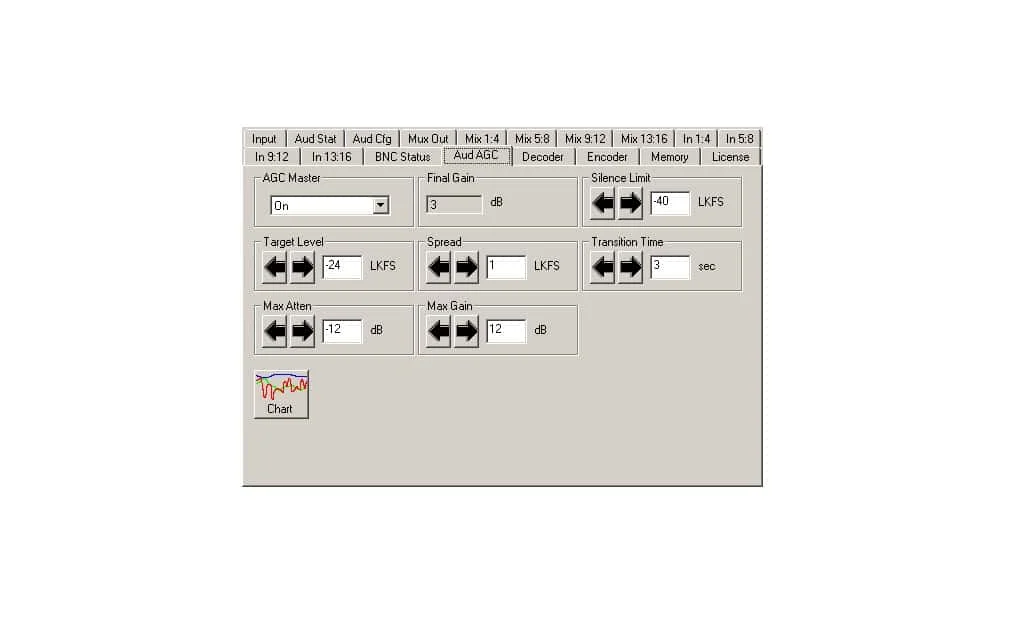
avenue_9670_gui-1021x623avenue_9670_gui-1021x623
  • Avenue 9670 Audio Automatic Gain and Loudness Control and 9690 Audio Compliance and Monitoring Software

    The LevelTrack™ Audio AGC option adds a user configurable audio level management system to Avenue signal processing modules. LevelTrack AGC corrects mismatched
    audio levels between different program sources or segments within a program. Errors of this type are regrettably common due to inconsistencies between different providers and program elements.

    1770 and VU Loudness Algorithms

    LevelTrack AGC provides two different approaches for adjusting audio levels: VU algorithms and the ITU-R1770 loudness algorithm. LevelTrack allows you to run your audio against a 1770 LKFS target range. These loudness measurements and adjustments conform to the ITU-R1770 specification. Loudness is frequency dependent and is weighed based upon case studies that reveal how humans perceive sound and loudness. Dialnorm™ values correspond to 1770 algorithms and contribute to compliance requirements. Alternately, VU algorithms may be used where audio levels are weighted with VU metering and measured in dBFS. The VU approach is particularly useful when calibrating and aligning equipment because it is a frequency independent method.

    Parameters and Control

    Range controls are provided for target level, spread, transition time, silence limit, and maximum gain and attenuation. This flexibility allows the operator to customize
    LevelTrack to suit the specific audio level challenges in a particular installation. All of these parameters can be easily adjusted through the Avenue Control System.

    LevelTrack adjusts the levels for up to 16 audio channels. Based upon the history in each channel, gradual changes are applied to prevent the audio level from dropping
    below or exceeding user programmable thresholds. This automatic level control can be applied on an individual channel, stereo pair, or 5.1 surround grouping. By adjusting the overall level of the signal, rather than masking the errors with compression, LevelTrack does not upset the internal dynamics of the program material.

    LevelTrack operates downstream of the manual audio level adjustments that are already provided in Avenue modules. This allows the automatic feature to assist the operator when needed by simply enabling the channel or grouping.

    Order Info:

    9670 LevelTrack Audio Automatic Gain Control Software Key Option
    9690 Audio Compliance and Monitoring Software

    Both are available as a software license and do not require any additional hardware.

    Audio Compliance and Monitoring Software is an option that can be added for compliance verification and archiving.

    Avenue Modules that can be used with LevelTrack AGC with Dialnorm / 1770 Algorithms and with Audio Compliance and Monitoring Software

    7555 HD / SD Video Processing Frame Synchronizer
    7660 HD / SD Embedder, Disembedder and Data Inserter
    9550 3G / HD / SD Video Processing Frame Synchronizer
    9600 3G / HD / SD Embedder, Disembedder and Data Inserter

    LevelTrack AGC Only. All of the below require 7610 or 8415 in order to use AGC (no 1770 support)

    7550 HD/SD Video Processing Frame Sync
    7600 HD / SD Embedder, Disembedder
    7900 HD Up/Down/Cross Converter
    7910 HD Upconverter and Cross Converter
    7920 HD Downconverter
    7930 HD Cross Converter
    7940 SD Aspect Ratio Converter
    Product Documents

    Datasheets

    • 9670 and 9690 Data Sheet
    • 9690 Audio Compliance

    Manuals

    • 9690 Module Manual
    • 9670 Module Manual

    Additional Resource

    • CALM Act, Dialnorm and Audio Loudness Whitepaper
    Contact Sales
    • Highlights
    • Specifications
    • Product Downloads

    Description

    • Automatic audio level and loudness control – simply enter your target Dialnorm value
    • CALM and 1770 compliant
    • Adjusts the overall level of the signal
    • Not a compressor limiter
    • Internal dynamics of the program material are maintained
    • Audio Compliance and Monitoring Software logs audio data and excursions

    Additional information

    Audio Features

    AGC

    Product Documents

    Datasheets

    • 9670 and 9690 Data Sheet
    • 9690 Audio Compliance

    Manuals

    • 9690 Module Manual
    • 9670 Module Manual

    Additional Resource

    • CALM Act, Dialnorm and Audio Loudness Whitepaper

    Related products you might be interested in

    BrightEye 15 SDl to Analog Converter with Frame Sync/GenlockBrightEye 15 is a digital to analog video converter with a timeable output. It’s perfect for feeding analog switchers and routers, where signal timing is required. BrightEye 15 has an SD SDI video input and a reference input. The input signal is converted to analog composite and synchronized (genlocked) to the reference signal. The analog composite output is fully timed with respect to the reference, including ScH phase. Basic controls are provided on the front panel. With the BrightEye Control app, you can control video proc functions; Gain, Chroma, Pedestal, and Hue. The vertical interval can be passed or blanked.
    BrightEye 10 Optical/SDI to Analog/SDI ConverterBrightEye 10 is a digital to analog video converter with both SD SDI (electrical) and fiber optic inputs. Output formats include Beta and SMPTE component, RGB, and composite (with simultaneous Y/C). Video processing, encoding and analog conversion is performed digitally at 12 bits of resolution with 8 x oversampling. Front panel controls select between the optical and SDI input, choose the analog output format, and adjust gain. Video levels can be adjusted through the BrightEye Control app. The reclocked SD SDI output follows the input selector, providing optical to electrical conversion when the optical input is selected. BrightEye 10 combines fiber to SD SDI conversion and QC monitoring in one compact unit.
    BrightEye 57 3G/HD/SD/Analog Test Signal and Sync Pulse GeneratorBrightEye 57 is a genlockable sync generator and test signal generator that can be used as either a slave or master reference generator. It can lock to house reference or it can lock to its own internal precision standard. BrightEye 57 is well suited for remote trucks, post, helicopters and fly packs. 1.5 Gb/s HD, 3 Gb/s HD or SD SDI test signals or black with embedder is output on the SDI BNCs. Composite, Tri-Level Sync and AES digital audio outputs are also provided. There are three user Programmable Outputs that are selectable between AES, LTC, Word clock or 6 Hz Pulse. Analog audio and AES outputs provide tone or silence. Color Black, Bars, Crosshatch, Multi-burst, and SDI Checkfield (Pathogenic) are just some of the signals simultaneously available on the SDI and analog composite outputs. The Cyclops feature adds a motion element to the selected video test signal. An ID slate with user programmable text can overlay the test pattern. The internal Time Code Generator feeds DVITC on the SDI outputs and VITC on the composite outputs, Time Code can also be selected in LTC form on the programmable Aux outputs. In addition to the standard suite of test patterns, users can create custom test patterns on a computer. Using BrightEye Pattern Generator software, simply transfer test patterns to the included Secure Digital flash memory card and then insert the memory card into the front of the BrightEye 57. Test patterns can include motion. File formats supported: .tga, .wav, .mp3, .wma. Many controls can be adjusted through the intuitive front panel. The BrightEye Control app provides a complete user interface for all adjustments and controls. For facilities and manufacturers using 3 Gb/s video, BrightEye units can be combined to form a complete 3G signal chain. The BrightEye 57 test signal generator’s 3G output can be distributed through the BrightEye 43 3G distribution amplifier or the BrightEye 46 and BrightEye 48 E/O 3G fiber optical transmitter/receiver set.
    BrightEye Control SoftwareBrightEye Control allows you to access all of the controls in your BrightEye devices. Adjust video levels, output timing and audio mixing and more. No DIP switches or button hold-downs are needed. Firmware updates, with feature enhancements and bug fixes, are provided for the lifetime of your BrightEye device. Install them with ease from your Mac or PC using BrightEye Control. The BrightEye Control software is included with each BrightEye at no charge. Version History 3.2.2 Fixes window resizing issue on Windows when using Hi-DPI displays. Only released for Windows (32-bit and 64-bit). 3.2.1 Hi-DPI Support on Windows. Control fixes and performance improvements. First Windows 64-bit build. Compatible with Windows 7, 8, 10, and 11 First Apple Silicon native release. Compatible with macOS 10.15+ 3.1.0 Built for Intel x86 64-bit. Compatible with Apple Silicon Macs via emulation. Compatible with macOS 10.15+ Only released for macOS. 3.0.2 Further improvements to connection reliability, especially with older BrightEye devices. Fixes issue with recalling saved settings on units with memory registers. Previously, recalling the saved settings could trigger memory register recalls. You can now set string controls to “”, which allows you to properly remove a feature license. Fixes several crashes related to connecting and disconnecting BrightEye devices. Other small fixes and enhancements. 3.0.1 Improved Connection Reliability Fixed problem where updating BrightEye firmware was sometimes slow. 3.0.0 Replaces BrightEye Mac and BrightEye PC. Improved user interface to make controlling BrightEye devices easier than ever. BrightEye devices now show up in the interface automatically, no need to manually refresh. Improved performance when controlling many BrightEye devices. Support for HiDPI and “Retina” displays. Fixed issues with firmware updates on newer Windows PC’s. Many other bug fixes and enhancements.

    Looking for something else?

    Signal Processing
    I.M.D.P.
    Monitors
    Timing
    Calibration
    Viewfinders

    Contact Sales

    International

    • Plura Europe GmbH Germany
    • Plura MEA Dubai – UAE
    • Plura ASIA Seoul – S. Korea

    The Americas

    • Arizona Plura Broadcast, Inc. HQ

    Stay in touch for news on the latest in product development

    Copyright © 2026 Plura Inc. All Rights Reserved.