• Skip to main content
  • Why Plura
    • Our Team
    • Videos
    • 15th Anniv.
    • Our History
    • Case Studies
    • Distributors
  • Products
    • At a Glance
    • X Processing
    • I.M.D.P.
    • Monitors
    • Timing
    • Calibration
    • Viewfinders
  • Support +
    • Downloads
    • Virtual Mtg.
    • RMA Request
  • News & Events
    • News
    • Events
  • Contact
  • Why Plura
    • Our Team
    • Videos
    • 15th Anniv.
    • Our History
    • Case Studies
    • Distributors
  • Products
    • At a Glance
    • X Processing
    • I.M.D.P.
    • Monitors
    • Timing
    • Calibration
    • Viewfinders
  • Support +
    • Downloads
    • Virtual Mtg.
    • RMA Request
  • News & Events
    • News
    • Events
  • Contact
Signal Processing
I.M.D.P.
Monitors
Timing
Calibration
Viewfinders
Home  //  Signal Processing  //  Avenue  //  Avenue 7900 HD Up/Down/Cross Converter
avenue_7900_front-1021x623avenue_7900_front-1021x623
  • Avenue 7900 HD Up/Down/Cross Converter

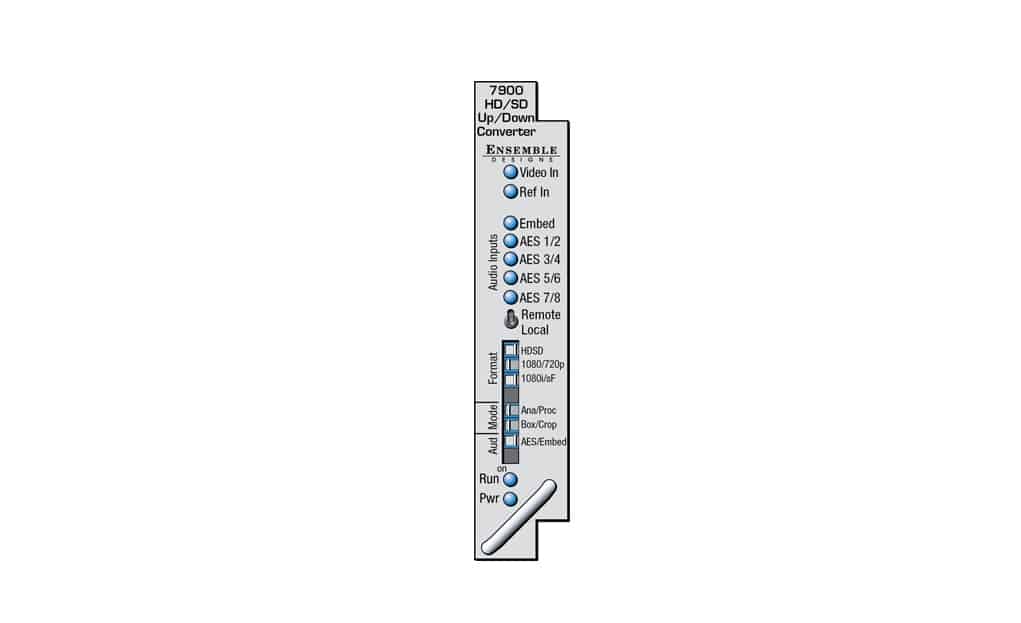
    The 7900 is a flexible, configurable Up and Downconverter for use in broadcast and post. It can process SD (Standard Definition) signals into HD, downconvert HD signals into standard definition, and perform Format and Aspect Ratio Conversion on both SD and HD signals. The 7900 and one of the optional audio sub modules together only occupy one slot in an Avenue frame – now that’s efficient use of space.

    It’s Smart – No Need for Configuration

    The 7900 can be configured to continually output your facility’s preferred HD format. Just connect any HD or SD signal to the input and the 7900 will convert it to the appropriate format for output. And, if the 8415 audio option is installed, the audio will have automatic delay compensation.

    Upconversion

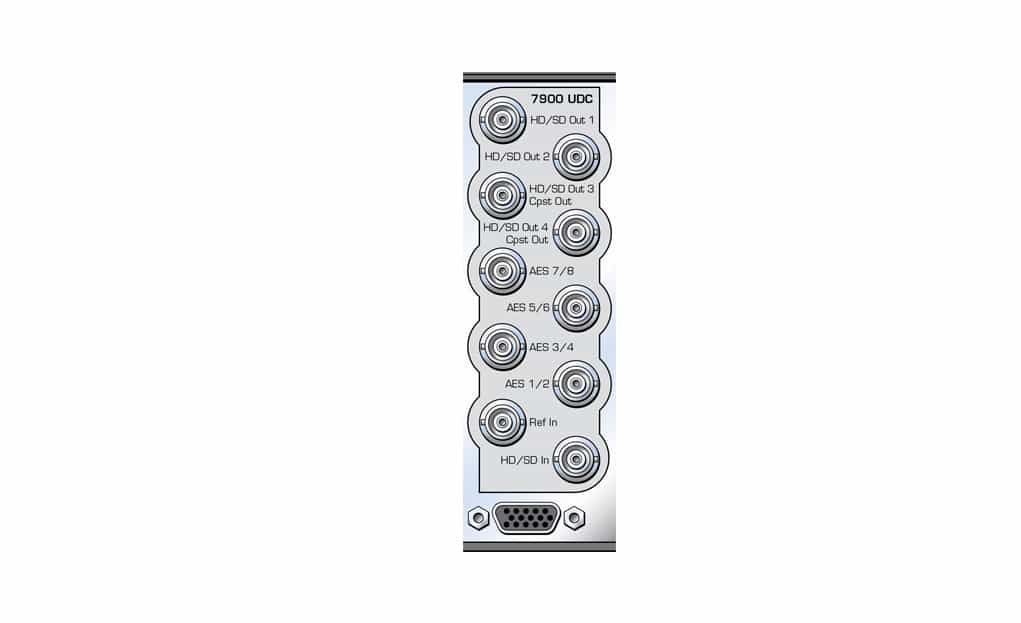
    When configured as an upconverter, the 7900 has a standard definition SDI input and four HD SDI outputs. Excellent for on-air use, the 7900 is equally at home in an HD island, in a signal ingest installation, or in a production application.

    The 7900 uses sophisticated Edge and Motion Adaptive Noise Reduction, ensuring delivery of a pristine output that is excellent for use in broadcast. All processing is performed on progressive signals at full bandwidth 4:4:4, for optimum signal quality. Signals are interlaced and deinterlaced as required with motion adaption and edge interpolation. Aspect ratio conversion choices include: Letterbox, Anamorphic, Crop and Zoom.

    Input standard and frame rate are auto-detected. The 7900 automatically performs 16 bit SD and HD color space conversion. The built-in Proc Amp provides adjustment of signal parameters with controls for Video, Chroma, Setup and Hue. Vertical interval data is faithfully preserved and is passed from SD to HD. The upconverted output is timeable with respect to the reference input.

    Downconversion

    When used as a downconverter, the 7900 has an HD SDI input and four outputs that can be configured as two SDI and two composite outputs, or four SDI outputs. Whether it’s providing digital feeds to production switchers and routers, or analog monitoring – the 7900 handles it all.

    The downconversion process includes Picture Detail Enhancement and Anti-Alias Filtering, which makes for a pristine SD output. The Aspect Ratio Conversion process offers Resizing and Repositioning with choices for: Letterbox, Anamorphic, Crop and Zoom. The 7900 automatically adjusts between HD and SD color space and gamma. Proc amp controls are provided in the form of Video, Chroma, Setup and Hue.

    Both the digital and analog outputs are timeable with respect to the reference input.

    Cross Conversion

    The 7900 provides cross conversion between HD 1.5 Gb/s formats, processing all popular variations of 1080 and 720, making it simple for every facility to ingest any type of HD signal.

    All popular variations of 720p, 1080i, 1080sF and 1080p are supported. The 7900 converts between any HD signals within the 59.94/23.98/29.97 family, within the 50/25 fps family, or within the 60/30 fps family. 3:2 pulldown is used when converting between 59.94 and 23.98. Film mode is automatically detected.

    Metadata

    HD closed captioning is carried in data packets in the vertical interval ancillary data space. The 7900 properly translates between HD caption data and traditional SD captioning (line 21 or 23) so that closed captioning content is converted transparently between video standards and formats.

    Automatic Aspect Ratio Conversion

    The 7900 supports AFD (Active Format Description) to mark or identify the aspect ratio of the video content. These flags are generated at the output of the module, and they are read at the input. This allows the up and downconversion process to adapt automatically to material that is already in letter or pillarbox form in order to produce the most appropriate conversion.

    Audio Options

    When an audio sub module is installed, audio is automatically delayed as needed to compensate for the video processing in the 7900. For complete audio processing, choose from three different audio sub modules. Sub modules plug onto the 7900 board and do not take up a slot in the frame.

    The 8415 is an eight-channel audio sub module with AES I/O that provides management of embedded audio in the processing path, or supports audio embedding/disembedding alongside the video processing elements. Embedded audio is safely bypassed around the video frame store with the lip sync preserved. Level adjustments and channel shuffling are accessed through the built-in audio mixer. The 9670 Automatic Gain Control option can be added to the 8415. All audio processing is performed at full 24 bit resolution.

    The 7610 provides carriage of up to eight channels of embedded audio through the format conversion process. Embedded audio in the input signal is delayed to match the video delay and preserve lip sync. The delayed content is reinserted in the video output. No level adjustment or channel swapping is provided.

    Complete Control System

    The 7900can be configured locally or controlled and configured remotely with Avenue 5050 Touch Screen, Avenue Tabletop Control Panel, Avenue Express Panel, or Avenue PC Software. Alarm generation, configurable user levels, module lock-out, and customizable menus are just some of the tools included in the Avenue control system.

    Product Documents

    Datasheet

    • 7900 Data Sheet

    Manual

    • 7900 Module Manual

    Firmware

    • Avenue 7900 Firmware v2.4.1
    Contact Sales
    • Highlights
    • Specifications
    • Product Downloads

    Description

    • Upconverter
    • Downconverter
    • Crossconverter
    • Aspect Ratio Converter
    • Smart auto-config – set output, then feed any input
    • Proc Amp and Frame Sync
    • Audio Mux/Demux optional
    • Audio Automatic Gain Control optional
    • Add audio sub module option for delay and processing
    • All processing performed on 4:4:4 progressive signals
    • Accepts asynchronous signals
    • Reference input – output is timeable
    • Automatically adjusts between SD/HD color space and gamma
    • 16 bit processing
    • Edge and Motion Adaptive Noise Reduction
    • Picture Detail Enhancement
    • Anti-Alias Filter
    • Passes closed captioning
    • Auto detection of input standard and frame rate
    • 3:2 pulldown
    • Built-in test pattern and tone
    • Local and remote control
    • Occupies one slot in frame, even with audio option
    Serial Digital Input
    • Number One
    • Signal Type HD Serial Digital 1.485 Gb/s
    • SMPTE 274M, 292M or 296M or SD Serial Digital 270 Mb/s
    • SMPTE 259M (Both 525 and 625 SD standards)
    • Impedance 75 Ω
    • Return Loss >15 dB
    • Max Cable Length 270 Mb/s 300 meters
    • 1.485 Gb/s 100 meters
    • Automatic Cable Input Equalization
    HD Standards Supported
    • 1080i (SMPTE 274M -4,5,6) 50, 59.94 or 60 Hz
    • 720p (SMPTE 296M -1,2,3) 50, 59.94 or 60 Hz
    • 1080p (SMPTE 274M -9,10,11) 23.98, 24, 25 Hz
    • 1080sF (RP211 -14,15,16) 23.98, 24, 25 Hz
    • 525i 59.94, 625i 50
    Serial Digital Output
    • Number Two, Three or Four Selectable
    • Signal Type SMPTE 274M, 292M or 296M when HD
    • SMPTE 259M (525 or 625) when SD
    • Impedance 75 Ω
    • Return Loss >15 dB
    • Output DC None (AC coupled)Delay
    • Adjustable from 1 field to 1 frame
    Reference Input
    • Number One external (modules BNC)
    • One internal (frame master ref BNC)
    • Signal Type PAL or NTSC composite video or HD Tri-Level Sync
    • Return Loss >40 dB (applies to external ref input)
    Analog Output (available when output is SD)
    • Number Two max (BNCs shared with SD SDI outputs)
    • Signal Type PAL or NTSC composite
    • Standard matches SDI output
    • Impedance 75 Ω
    • Return Loss >40 dB
    • Output DC <50 mV
    • Bit Resolution 12 bit output reconstruction 8 x oversampling
    • Signal to Noise >65 dB
    • Frequency Response ±0.1 dB, 0 to 5.5 MHz
    • K Factor <1%
    • Differential Phase <1 degree
    • Differential Gain <1%
    Conversion Directions
    • Up/Down Conversion between
    • 525 (NTSC) and 1080i/59.94, 720p/59.94, 1080p/23.98, 1080sF/23.98
    • 625 (PAL) and 1080i/50, 720p/50, 1080p/25, 1080sF/25
    • Cross Conversion within frame rate families
    • 525 Derived Family: 1080i/59.94, 720p/59.94, 1080p/23.98, 1080sF/23.98
    • 625 Derived Family: 1080i/50, 720p/50, 1080p/25, 1080sF/25
    AES/EBU Digital Inputs (with 8415 sub module option)
    • Number Four (total of 8 channels)
    • Signal Type AES3id
    • Connectorization Coaxial, 75 Ω
    • Bit Depth 20 and 24 bit
    • Sample Rate 30 kHz to 100 kHz (sample rate converted internally to 48 kHz)
    • Crosstalk <144 dB
    • Dynamic Range >144 dB
    • Reference Level -18 or -20 dBFS (selectable)
    • AC-3, Dolby E Supported when inputs are synchronous
    Embedded Inputs
    • Number Four AES Streams (from video input)
    • Eight channels from any two of four groups
    • Selectable to any of four groups
    • Channels Eight
    • Bit Depth 20 and 24 bit
    AES/EBU Digital Outputs
    • Number Four (total of eight channels)
    • Signal Type AES3id
    • Connectorization Coaxial, 75 Ω
    • Bit Depth 20 and 24 bit
    • Sample Rate 48 kHz Synchronous to video output
    • Reference Level -18 or -20 dBFS (selectable)
    Embedded Output
    • Number Four or two depending on configuration
    • Group Assign Cascade or replace any two of four groups
    • Channels Eight
    • Bit Depth 24 bit
    General Specifications
    • Power Consumption 10 watts
    • Temperature Range 0 to 40°C ambient (all specs met)
    • Relative Humidity 0 to 95%, noncondensing
    • Altitude 0 to 10,000 ft

    Product Documents

    Datasheet

    • 7900 Data Sheet

    Manual

    • 7900 Module Manual

    Firmware

    • Avenue 7900 Firmware v2.4.1

    Related products you might be interested in

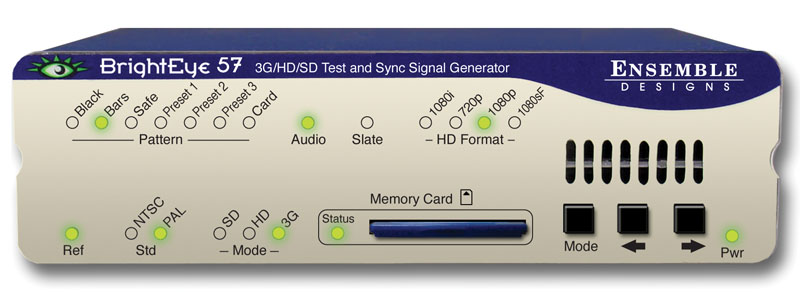
    BrightEye 57 3G/HD/SD/Analog Test Signal and Sync Pulse GeneratorBrightEye 57 is a genlockable sync generator and test signal generator that can be used as either a slave or master reference generator. It can lock to house reference or it can lock to its own internal precision standard. BrightEye 57 is well suited for remote trucks, post, helicopters and fly packs. 1.5 Gb/s HD, 3 Gb/s HD or SD SDI test signals or black with embedder is output on the SDI BNCs. Composite, Tri-Level Sync and AES digital audio outputs are also provided. There are three user Programmable Outputs that are selectable between AES, LTC, Word clock or 6 Hz Pulse. Analog audio and AES outputs provide tone or silence. Color Black, Bars, Crosshatch, Multi-burst, and SDI Checkfield (Pathogenic) are just some of the signals simultaneously available on the SDI and analog composite outputs. The Cyclops feature adds a motion element to the selected video test signal. An ID slate with user programmable text can overlay the test pattern. The internal Time Code Generator feeds DVITC on the SDI outputs and VITC on the composite outputs, Time Code can also be selected in LTC form on the programmable Aux outputs. In addition to the standard suite of test patterns, users can create custom test patterns on a computer. Using BrightEye Pattern Generator software, simply transfer test patterns to the included Secure Digital flash memory card and then insert the memory card into the front of the BrightEye 57. Test patterns can include motion. File formats supported: .tga, .wav, .mp3, .wma. Many controls can be adjusted through the intuitive front panel. The BrightEye Control app provides a complete user interface for all adjustments and controls. For facilities and manufacturers using 3 Gb/s video, BrightEye units can be combined to form a complete 3G signal chain. The BrightEye 57 test signal generator’s 3G output can be distributed through the BrightEye 43 3G distribution amplifier or the BrightEye 46 and BrightEye 48 E/O 3G fiber optical transmitter/receiver set.
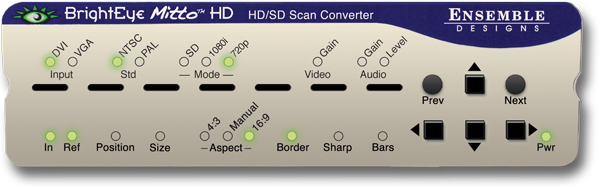
    BEM-2-H, BrightEye Mitto HD, HD/SD Scan Converter w/ HDCP SupportUse BrightEye Mitto™ HD BEM-2-H to deliver DVI, HDMI, and VGA sources to HD and SD SDI destinations. Ensemble Designs’ proprietary scaling and filtering technology ensures that Mitto always produces a pristine, detailed video output. Even the most demanding CGI material is faithfully rendered to television. YouTube, Zoom, Tik-Tok, and Everything Else Made Easy Take just about any source to HD or SD SDI video. Computer video can now be used for the most demanding applications including broadcast, high-end military, medical, classroom, church and corporate. Just a small part of the screen, such as a Tik-Tok video, can be selected with a mouse and converted to full screen HD. Mitto delivers the best looking video – compare Mitto to any other scan converter and see the difference! Choose the Functionality You Need Choose the best combination of features and price for your application. Eight different Mitto units offer varying types of outputs and capabilities. All Mitto units accept VGA, DVI and HDMI input signals from PC and Mac computers. HDCP is not a Problem; Many systems now require HDCP for video playback, regardless of content licensing. BEM-2-H can handle HDCP encrypted content with the added BEM-HDCP option. Muting Disable available with the purchase of option BEM-HDCP license and signed waiver. BrightEye Control Software Using BrightEye control software, you can easily time BrightEye Mitto into a video production switcher or router. From your desktop, you have complete and intuitive control of video format, video levels, output timing, mixing audio channels, and audio delay. Pristine, Detailed Video Output A superior quality scan converter, BrightEye Mitto has the advantage of proprietary scaling technology and exclusive multi-tap filtering. Even a small part of the computer screen, such as a YouTube video, will be upconverted to full screen HD. The region selected for output determines if Mitto acts as an up converter or downconverter. The output looks as good, or better, than the original and passes the most stringent testing. Easy To Use Use the Selection Tool in BrightEye Control to select what portion of the screen you want to output. The Selection Tool floats over the content on your display, showing the portion of the video that will be output from BrightEye Mitto. Use Your Mouse To Select What is Output to Video Use your mouse to click and drag over the specific portion of computer video that you want to output. The perspective of seeing the whole screen relative to your selection gives you the ability to choose exactly which portion of the video you want to scan convert for output. Resize the selection window by clicking and dragging with your mouse. Mitto’s video output automatically goes to pillarbox or letterbox as needed. Mitto automatically maintains perfect aspect ratio. Digital and Analog Video and Audio The intuitive front panel interface makes it easy to choose the desired video output format. The genlock reference input allows the video outputs to be timed to house. Audio can be input through the DVI (or HDMI with adapter) input, or the 3.5mm audio input. The audio input accepts analog audio or AES digital audio. Audio is embedded into the SDI outputs – which is required for many high end applications. Audio delay controls let you adjust the audio timing with respect to video for perfect lip sync, which is crucial when using Zoom, Google Meet, or Microsoft Teams video in a production environment.
    BrightEye 15 SDl to Analog Converter with Frame Sync/GenlockBrightEye 15 is a digital to analog video converter with a timeable output. It’s perfect for feeding analog switchers and routers, where signal timing is required. BrightEye 15 has an SD SDI video input and a reference input. The input signal is converted to analog composite and synchronized (genlocked) to the reference signal. The analog composite output is fully timed with respect to the reference, including ScH phase. Basic controls are provided on the front panel. With the BrightEye Control app, you can control video proc functions; Gain, Chroma, Pedestal, and Hue. The vertical interval can be passed or blanked.
    BrightEye 41 Video/AES/Tri-Level Sync Distribution AmplifierBrightEye 41 is a distribution amplifier that accepts analog video, AES digital audio, or Tri-Level Sync signal. It can also be used with SMPTE 310M, Dolby E and AC-3 signals. It provides unity gain fanout over a frequency range of DC to 10 MHz. It can handle composite and component analog video, coaxial AES digital audio, or a High Definition Tri-Level Sync signal. When using a digital to analog video converter and multiple outputs are needed, BrightEye 41 can be used to distribute and provide those additional output signals. BrightEye 41 works well with video converters BrightEye 10 and BrightEye 16. BrightEye 41 is also useful in conjunction with any of the BrightEye SPG/TSGs, for distributing Tri-Level Sync, AES and composite signals.

    Looking for something else?

    Signal Processing
    I.M.D.P.
    Monitors
    Timing
    Calibration
    Viewfinders

    Contact Sales

    International

    • Plura Europe GmbH Germany
    • Plura MEA Dubai – UAE
    • Plura ASIA Seoul – S. Korea

    The Americas

    • Arizona Plura Broadcast, Inc. HQ

    Stay in touch for news on the latest in product development

    Copyright © 2026 Plura Inc. All Rights Reserved.