• Skip to main content
  • Why Plura
    • Our Team
    • Videos
    • 15th Anniv.
    • Our History
    • Case Studies
    • Distributors
  • Products
    • At a Glance
    • X Processing
    • I.M.D.P.
    • Monitors
    • Timing
    • Calibration
    • Viewfinders
  • Support +
    • Downloads
    • Virtual Mtg.
    • RMA Request
  • News & Events
    • News
    • Events
  • Contact
  • Why Plura
    • Our Team
    • Videos
    • 15th Anniv.
    • Our History
    • Case Studies
    • Distributors
  • Products
    • At a Glance
    • X Processing
    • I.M.D.P.
    • Monitors
    • Timing
    • Calibration
    • Viewfinders
  • Support +
    • Downloads
    • Virtual Mtg.
    • RMA Request
  • News & Events
    • News
    • Events
  • Contact
Signal Processing
I.M.D.P.
Monitors
Timing
Calibration
Viewfinders
Home  //  Signal Processing  //  Avenue  //  Avenue 9455 3G Clean and Quiet Protection Switch
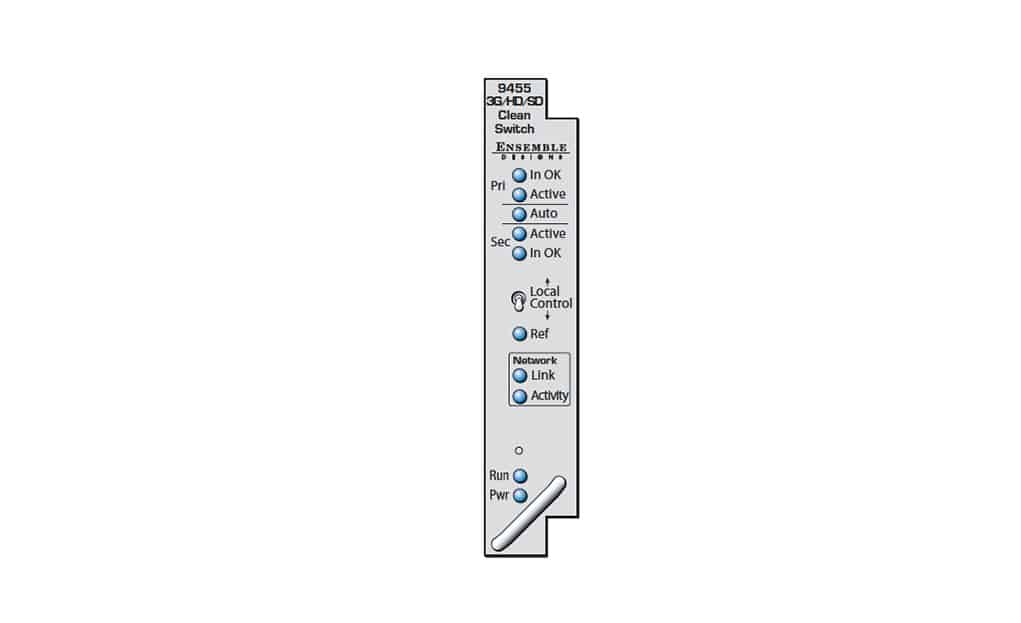
avenue_9455_front-1021x623avenue_9455_front-1021x623
  • Avenue 9455 3G Clean and Quiet Protection Switch

    The 9455 module is a clean and quiet protection switch for critical broadcast and satellite feeds. It switches cleanly between asynchronous sources which means it can be used live to air. The module has a full video frame synchronizer, rather than a line delay, ensuring perfect alignment of mis-timed and non-synchronous SDI sources.

    Clean and quiet switching between sources requires that they be synchronous and precisely timed to each other. The 9455 accomplishes this automatically, with integral frame synchronization of the inputs, allowing operation with both synchronous and asynchronous (wild) sources. This frame synchronization feature not only means that the output of the 9455 will always be stable and glitch-free, but it also means that in the event of a total loss of both inputs, consistently timed color black will still be output.

    These internal frame synchronizers can be genlocked to an external reference signal so that the output of the 9455 is synchronous to local sources. Alternately, in teleports, headends, and other multi-service facilities, where there is no logical common reference, the 9455 will internally generate an accurate reference.

    The delay through the 9455 can be adjusted from one to eight frames, with independent control for the Primary and Secondary input paths. By operating with several frames of delay, the fault detection algorithms are given enough time to detect a failure in an input signal and switch to the backup before the fault has actually appeared on-air.

    Perfect Audio

    Glitch-free, quiet switching of embedded audio signals is achieved with the 9455’s precise synchronization and alignment of audio sources. Digital audio is de-embedded, and if it is linear PCM, sample rate converted, switched, and re-embedded. Encoded audio streams such as Dolby™ E are de-embedded and re-embedded but not processed in any way. PCM audio is supported with asynchronous sources, operation of encoded audio requires all sources to be synchronous, but not necessarily in time.

    Switch Logic

    When a fault is detected in the primary input to the 9455, and the secondary input is verified as good, the switch will activate, causing the secondary input to be switched to the module’s output. The 9455 includes a passive, fail-safe path that ensures there is an output even in the event of a total power failure. The module can be set to automatically switch back to the primary after the fault condition clears. If both the primary and the secondary inputs signals are faulted, no switch occurs.

    The health of a high definition or standard definition video signal is determined by monitoring crucial parameters in order of increasing complexity; Timing Reference Signal (TRS), or a persistent loss of digital sync is tested first. Black, Embedded Audio and Freeze are also evaluated. Each test can be configured by the user. For example, the sophisticated Black Detector includes configurable parameters for black level threshold, pixel count, and duration time.

    The Freeze detection system can be set to detect a clean or noisy source. Freeze Time sets the number of seconds for the 9455 to switch to the secondary input after a video freeze condition is detected in the primary input.

    Control and Alarms

    Module controls are easily accessed through an Avenue Control Panel, Avenue PC software, GPIs, or the module’s front edge controls. GPI inputs allow faults detected in upstream equipment to contribute to the switching logic.

    Product Documents

    Datasheet

    • 9455 Data Sheet

    Manual

    • 9455 and 7435 Module Manual

    Firmware

    • Avenue 9455 Firmware v1.0.7
    Contact Sales
    • Highlights
    • Specifications
    • Product Downloads

    Description

    • Clean and quiet switch for 3G, HD and SD SDI signals
    • Use for clean switching of asynchronous sources for critical, live feeds
    • Full frame synchronizer with adjustable delay
    • Quiet audio switching
    • Passes embedded audio
    • External genlock reference input
    • GPIs and TCP/IP for automation control
    • Fail-safe bypass in case of power failure
    • Local and remote control
    • Memory Registers
    Input
    • Number Two
    • Signal Type HD Serial Digital 1.485 Gb/s
    • SMPTE 274M, 292M or 296M,
    • HD Serial Digital 2.97 Gb/s
    • SMPTE 424M, 425M,
    • SD Serial Digital 270 Mb/s
    • SMPTE 259M,
    • Data as per SMPTE 337M
    • Impedance 75 Ω
    • Return Loss >15 dB to 1.5 GHz
    • Max Cable Length 270 Mb/s 300 meters
    • 1.485 Gb/s 100 meters
    • 2.97 Gb/s 70 meters
    • Automatic Cable Input Equalization
    Standards Supported
    • 1080i 50, 59.94 or 60 Hz, SMPTE 274M -4,5,6
    • 720p 50, 59.94 or 60 Hz, SMPTE 296M -1,2,3
    • 1080p 23.98, 24 or 25 Hz, SMPTE 274M -9,10,11
    • 1080p 50, 59.94 Hz, SMPTE 424M, 425M Level A
    • 1080sF 23.98, 24 or 25 Hz, RP211 -14,15,16
    • 625i 50, 525i 59.94
    Serial Digital Loopback
    • Number Two total
    • One primary
    • One secondary
    • Impedance 75 Ω
    Output
    • Number Six (includes one fail-safe bypass)
    • Signal Type HD or SD Serial Digital, follows input
    • Delay Adjustable up to 8 frames
    • Impedance 75 Ω
    • Return Loss >15 dB DC to 1.5 GHz
    Reference Input
    • Number One external (modules BNC)
    • One internal (frame master ref BNC)
    • Signal Type PAL or NTSC composite video or
    • HD Tri-Level Sync
    • Return Loss >40 dB
    General Specifications
    • Power Consumption 10 watts
    • Temperature Range 0 to 40°C ambient (all specs met)
    • Relative Humidity 0 to 95%, noncondensing
    • Altitude 0 to 10,000 ft

    Product Documents

    Datasheet

    • 9455 Data Sheet

    Manual

    • 9455 and 7435 Module Manual

    Firmware

    • Avenue 9455 Firmware v1.0.7

    Related products you might be interested in

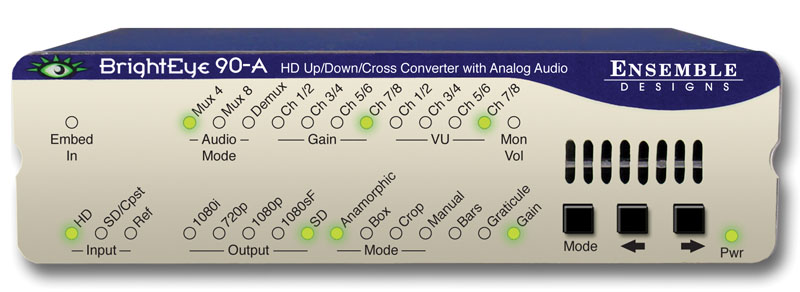
    BrightEye 90-A HD Up/Down Cross Converter and ARC with Analog AudioBrightEye 90-A is a versatile up/down/cross converter or aspect ratio converter for use with analog and digital video signals. Simply set the BrightEye 90-A to output your facility’s preferred HD or SD standard. The BrightEye 90-A will accommodate whatever input you connect – analog composite, SD SDI or HD SDI. After setting the output standard, BrightEye 90-A automatically converts the selected input to the correct standard for your facility. BrightEye 90-A will upconvert, downconvert, cross convert, or act as an ARC, as needed. The built-in Frame Synchronizer allows you to feed asynchronous signals to the BrightEye 90-A. An external reference input allows genlock to a house reference. All vertical interval data and closed captioning is faithfully passed. Upconverting to High Definition Feed the analog composite or SD SDI output of a camera to a BrightEye 90-A and upconvert to HD. You can take the HD signal from the BrightEye 90-A into a switcher or projection system. Upconverting existing SD equipment lets you leverage the equipment you already have and operate in the HD domain. While some cameras may have firewire out, using the video output and upconverting before distribution is preferable since longer cable runs can be achieved and quality is superior. Additionally, the BrightEye 90-A’s reference input allows you to time the upconverted video output for use with a production switcher. Downconverting to Standard Definition BrightEye 90-A will downconvert any type of HD signal and provides both an SD SDI and an analog composite output suitable for broadcast or monitoring. Cross Conversion It’s easy to convert between various HD standards, whether 720p or 1080i. Simply select the output standard you need and connect the input, that’s all there is to it. Aspect Ratio Conversion For converting between SD 4:3 and HD 16:9, BrightEye 90-A has you covered. Just select the output standard you need and connect the input. Audio Processing Made Simple BrightEye 90-A handles both embedded audio and eight channels of analog audio. Sixteen channels of embedded audio are supported in BrightEye 90-A. If the incoming video has embedded audio, the audio will be safely bypassed around the video processing and lipsync will be preserved. Audio mixing is available for two of the four embedded groups of audio. The analog audio I/O ports can be configured for eight channels of incoming audio or for eight channels of audio output. The audio mixer can be used for analog audio as well. Mixer controls are accessed through the BrightEye Control Software. Monitoring for Video and Audio Audio monitoring is easy with BrightEye 90-A’s convenient 3.5mm mini jack. Select the audio channels you want to monitor from the front panel and plug in a headset. The HDMI connector on the rear of the unit provides a future proof monitoring interface. Plug it into most LCD monitors for confidence monitoring of your feed. Front Panel and Software Control Input selection, gain control, and test pattern controls are provided through the front panel interface. Audio presence LEDs indicate which channels are detected. Controls for crop, letterbox and pillarbox are accessed from the front panel or BrightEye Mac or PC software. Video and audio levels and the audio mixer can be adjusted through BrightEye Mac or PC software.
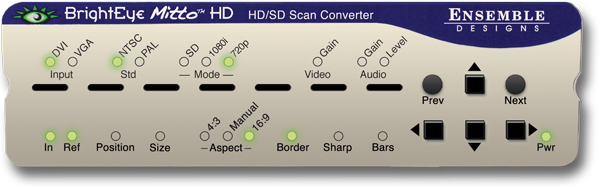
    BEM-1-H, BrightEye Mitto 3G, 3G/HD/SD Scan Converter w/HDCP SupportUse BrightEye Mitto™ BEM-1-H to deliver DVI, HDMI, and VGA sources to 3G, HD and SD SDI video resolutions. Ensemble Designs’ proprietary scaling and filtering technology ensures that Mitto always produces a pristine, detailed video output. Even the most demanding CGI material is faithfully rendered to television. YouTube, Zoom, Tik-Tok, and Everything Else Made Easy Take just about any source to 3G, HD or SD SDI video. Computer video can now be used for the most demanding applications including broadcast, high-end military, medical, classroom, church and corporate. Just a small part of the screen, such as a Tik-Tok video, can be selected with a mouse and converted to full screen HD. Mitto delivers the best looking video – compare Mitto to any other scan converter and see the difference! HDCP is not a Problem Many systems now require HDCP for video playback, regardless of content licensing. BEM-2-H can handle HDCP encrypted content with the added BEM-HDCP option. Muting Disable available with the purchase of option BEM-HDCP license and signed waiver. BrightEye Control Software Using BrightEye control software, you can easily time BrightEye Mitto into a video production switcher or router. From your desktop, you have complete and intuitive control of video format, video levels, output timing, mixing audio channels, and audio delay. Pristine, Detailed Video Output A superior quality scan converter, BrightEye Mitto has the advantage of proprietary scaling technology and exclusive multi-tap filtering. Even a small part of the computer screen, such as a YouTube video, will be upconverted to full screen HD. The region selected for output determines if Mitto acts as an up converter or downconverter. The output looks as good, or better, than the original and passes the most stringent testing. Easy To Use Use the Selection Tool in BrightEye Control to select what portion of the screen you want to output. The Selection Tool floats over the content on your display, showing the portion of the video that will be output from BrightEye Mitto. Use Your Mouse To Select What is Output to Video Use your mouse to click and drag over the specific portion of computer video that you want to output. The perspective of seeing the whole screen relative to your selection gives you the ability to choose exactly which portion of the video you want to scan convert for output. Resize the selection window by clicking and dragging with your mouse. Mitto’s video output automatically goes to pillarbox or letterbox as needed. Mitto automatically maintains perfect aspect ratio. Digital and Analog Video and Audio The intuitive front panel interface makes it easy to choose the desired video output format. The genlock reference input allows the video outputs to be timed to house. Audio can be input through the DVI (or HDMI with adapter) input, or the 3.5mm audio input. The audio input accepts analog audio or AES digital audio. Audio is embedded into the SDI outputs – which is required for many high end applications. Audio delay controls let you adjust the audio timing with respect to video for perfect lip sync, which is crucial when using Zoom, Google Meet, or Microsoft Teams video in a production environment.
    BrightEye 16 SDI to Analog Video Converter with Frame Sync/Genlock and Audio DisembedderBrightEye 16 is a digital to analog video converter with a timeable output. It’s perfect for feeding analog switchers and routers, where signal timing is required. It’s also a disembedder and provides four analog audio outputs. With timing controls, proc adjustments, and a built-in audio mixer, BrightEye 16 provides a complete solution for digital to analog conversion. BrightEye 16 has an SDI video input and a reference input. The input signal is converted to analog composite and synchronized (genlocked) to the reference signal. The analog composite output is fully timed with respect to the reference, including ScH phase. Audio is disembedded with 24 bit precision and converted to analog. Basic controls are accessed on the front panel. Use the BrightEye Control app to access video proc controls and the built-in audio mixer. The vertical interval can be passed or blanked. VU indication is provided on the front panel and BrightEye Control.
    BrightEye 30 Audio ADC and DACBrightEye 30 is a flexible audio converter that can be a two channel, bi-directional ADC and DAC, or it can be configured as a four channel converter. Perfect in desktop, post and broadcast applications, 24 bit processing ensures beautiful audio. As a bi-directional converter, two channels of analog audio are converted to AES digital audio and at the same time an AES stream is converted to two channels of analog. Alternately, the unit can be configured as a four channel AES to analog converter or a four channel analog to AES converter. BrightEye 30 also serves as a sample rate converter. For example, a digital 44.1 KHz signal from a CD player can be fed to the input and a digital AES3id, 48 KHz signal synchronous to the reference input will be output. Audio mixing, level adjustments, and channel shuffling are accessed through the BrightEye Control app. A variety of audio connectors and adapters are available for integrating BrightEye 30 to any type of system. A reference input is provided which allows digital outputs to be synchronized to either a PAL or NTSC video signal or AES reference.

    Looking for something else?

    Signal Processing
    I.M.D.P.
    Monitors
    Timing
    Calibration
    Viewfinders

    Contact Sales

    International

    • Plura Europe GmbH Germany
    • Plura MEA Dubai – UAE
    • Plura ASIA Seoul – S. Korea

    The Americas

    • Arizona Plura Broadcast, Inc. HQ

    Stay in touch for news on the latest in product development

    Copyright © 2026 Plura Inc. All Rights Reserved.