• Skip to main content
  • Why Plura
    • Our Team
    • Videos
    • 15th Anniv.
    • Our History
    • Case Studies
    • Distributors
  • Products
    • At a Glance
    • X Processing
    • I.M.D.P.
    • Monitors
    • Timing
    • Calibration
    • Viewfinders
  • Support +
    • Downloads
    • Virtual Mtg.
    • RMA Request
  • News & Events
    • News
    • Events
  • Contact
  • Why Plura
    • Our Team
    • Videos
    • 15th Anniv.
    • Our History
    • Case Studies
    • Distributors
  • Products
    • At a Glance
    • X Processing
    • I.M.D.P.
    • Monitors
    • Timing
    • Calibration
    • Viewfinders
  • Support +
    • Downloads
    • Virtual Mtg.
    • RMA Request
  • News & Events
    • News
    • Events
  • Contact
I.M.D.P.
Monitors
Timing
Calibration
Viewfinders

Signal Processing

Best-in-class “glue” products tying media system together. Flexible, frame-based and compact signal processing products for video facilities includes modules for video up/down conversion, audio embedding, synchronization, conversion, routing, noise reduction, protection switches, test signal generators and more. We support IP-2110 / 4K / UHD / FHD Video, MPEG, Analog Video and Audio processing.
  • Home
  • Products
  • Signal Processing

Signal Processing

Best-in-class “glue” products tying media system together.
Flexible, frame-based and compact signal processing products for video facilities includes modules for video up/down conversion, audio embedding, synchronization, conversion, routing, noise reduction, protection switches, test signal generators and more. We support IP-2110 / 4K / UHD / FHD Video, MPEG, Analog Video and Audio processing.

Product Filters
Series
Form-Factor
Video Input
Video Output
Video Processing
Audio Features
Sync Pulse/Test Signal
Control
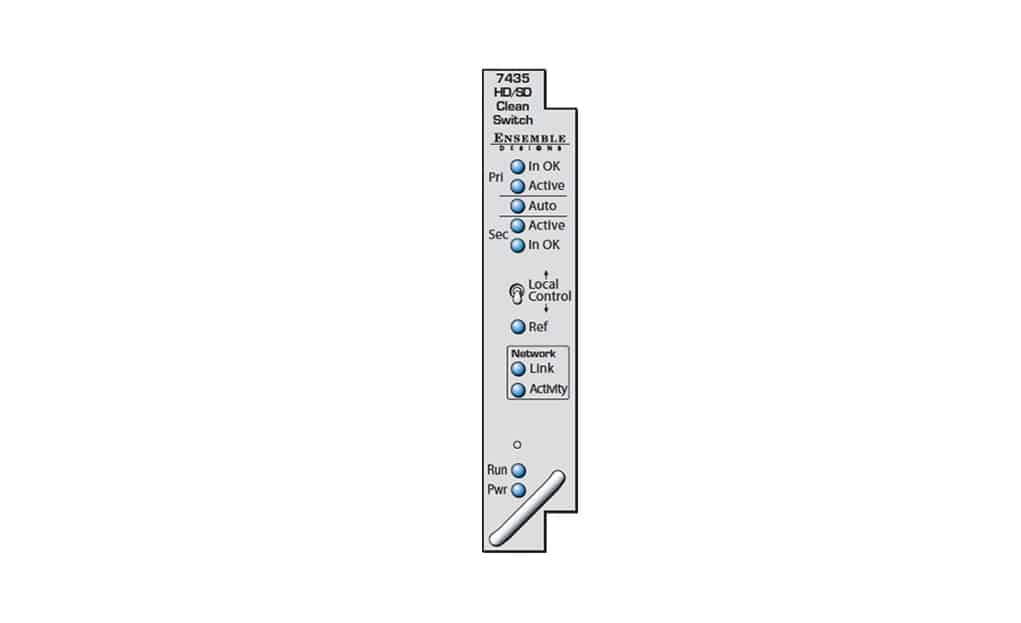
Avenue 7435 HD / SD Clean and Quiet Protection Switch
The 7435 module is a clean and quiet protection switch for critical broadcast and satellite feeds. It switches cleanly between asynchronous sources which means it can be used live to air. The module has a full video frame synchronizer, rather than a line delay, ensuring perfect alignment of mis-timed and non-synchronous SDI sources. Clean and quiet switching between sources requires that they be synchronous and precisely timed to each other. The 7435 accomplishes this automatically, with integral frame synchronization of the inputs, allowing operation with both synchronous and asynchronous (wild) sources. This frame synchronization feature not only means that the output of the 7435 will always be stable and glitch-free, but it also means that in the event of a total loss of both inputs, consistently timed color black will still be output. These internal frame synchronizers can be genlocked to an external reference signal so that the output of the 7435 is synchronoA Clean Switch That’s Glitch-Free The 7435 module is a clean and quiet protection switch for critical broadcast and satellite feeds. It switches cleanly between asynchronous sources which means it can be used live to air. The module has a full video frame synchronizer, rather than a line delay, ensuring perfect alignment of mis-timed and non-synchronous SDI sources. Clean and quiet switching between sources requires that they be synchronous and precisely timed to each other. The 7435 accomplishes this automatically, with integral frame synchronization of the inputs, allowing operation with both synchronous and asynchronous (wild) sources. This frame synchronization feature not only means that the output of the 7435 will always be stable and glitch-free, but it also means that in the event of a total loss of both inputs, consistently timed color black will still be output. These internal frame synchronizers can be genlocked to an external reference signal so that the output of the 7435 is synchronous to local sources. Alternately, in teleports, headends, and other multi-service facilities, where there is no logical common reference, the 7435 will internally generate an accurate reference. The delay through the 7435 can be adjusted from one to eight frames, with independent control for the Primary and Secondary input paths. By operating with several frames of delay, the fault detection algorithms are given enough time to detect a failure in an input signal and switch to the backup before the fault has actually appeared on-air. Perfect Audio Glitch-free, quiet switching of embedded audio signals is achieved with the 7435’s precise synchronization and alignment of audio sources. Digital audio is de-embedded, and if it is linear PCM, sample rate converted, switched, and re-embedded. Encoded audio streams such as Dolby™ E are de-embedded and re-embedded but not processed in any way. PCM audio is supported with asynchronous sources, operation of encoded audio requires all sources to be synchronous, but not necessarily in time. Switch Logic When a fault is detected in the primary input to the 7435, and the secondary input is verified as good, the switch will activate, causing the secondary input to be switched to the module’s output. The 7435 includes a passive, fail-safe path that ensures there is an output even in the event of a total power failure. The module can be set to automatically switch back to the primary after the fault condition clears. If both the primary and the secondary inputs signals are faulted, no switch occurs. The health of a high definition or standard definition video signal is determined by monitoring crucial parameters in order of increasing complexity; Timing Reference Signal (TRS), or a persistent loss of digital sync is tested first. Black, Embedded Audio and Freeze are also evaluated. Each test can be configured by the user. For example, the sophisticated Black Detector includes configurable parameters for black level threshold, pixel count, and duration time. The Freeze detection system can be set to detect a clean or noisy source. Freeze Time sets the number of seconds for the 7435 to switch to the secondary input after a video freeze condition is detected in the primary input. Control and Alarms Module controls are easily accessed through an Avenue Control Panel, Avenue PC software, GPIs, or the module’s front edge controls. GPI inputs allow faults detected in upstream equipment to contribute to the switching logic. us to local sources. Alternately, in teleports, headends, and other multi-service facilities, where there is no logical common reference, the 7435 will internally generate an accurate reference.
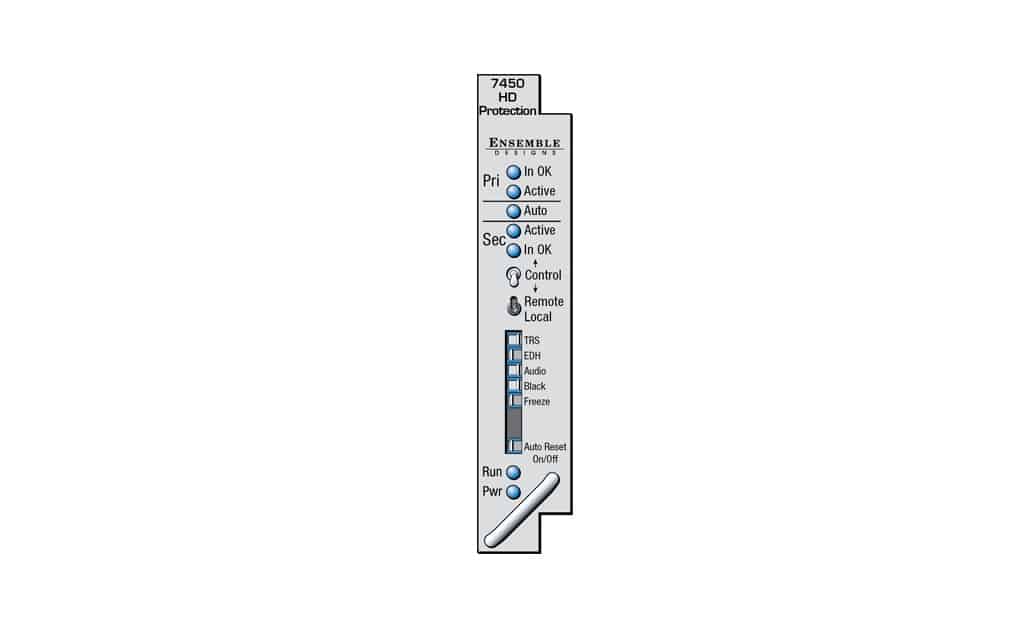
Avenue 7450 HD Protection Switch
The 7450 module is a fail-safe, bypass protection switch for critical digital paths for broadcast or satellite applications. When a fault is detected in the primary input, and the secondary input is verified as good, the switch will activate, causing the secondary input to be switched to the module’s output. The 7450 includes a passive, fail-safe path that ensures there is an output even in the event of a total power failure. The 7450 supports HD SDI signals. Different types of signal testing (vetting) can be enabled on the 7450 and it will apply the tests automatically and independently for the Primary and Secondary inputs. The health of a high definition video signal is determined by monitoring crucial parameters in order of increasing complexity; Timing Reference Signal (TRS), or a persistent loss of digital sync is tested first. Black, Embedded Audio and Freeze are also evaluated. Each test can be configured by the user. For example, the sophisticated Black Detector includes configurable parameters for black level threshold, pixel count, and duration time. The Freeze detection system can be set to detect a clean or noisy source. Freeze Time sets the number of seconds for the 7450 to switch to the secondary input after a video freeze condition is detected in the primary input. The switch can operate in two modes: automatic or nonresetting. In fully automatic mode, the 7450 will automatically switch back to the primary signal once it’s been restored. In the non-resetting mode, the secondary input remains routed to the output, even after the primary input has recovered. The 7450 can be configured locally or controlled and configured remotely with Avenue 5050 Touch Screen, Avenue Tabletop Control Panel, Avenue Express Panel, or Avenue PC Software. Alarm generation, configurable user levels, module lock-out, and customizable menus are just some of the tools included in the Avenue control system.
Avenue 7455 HD/SD/ASI/310 Protection Switch
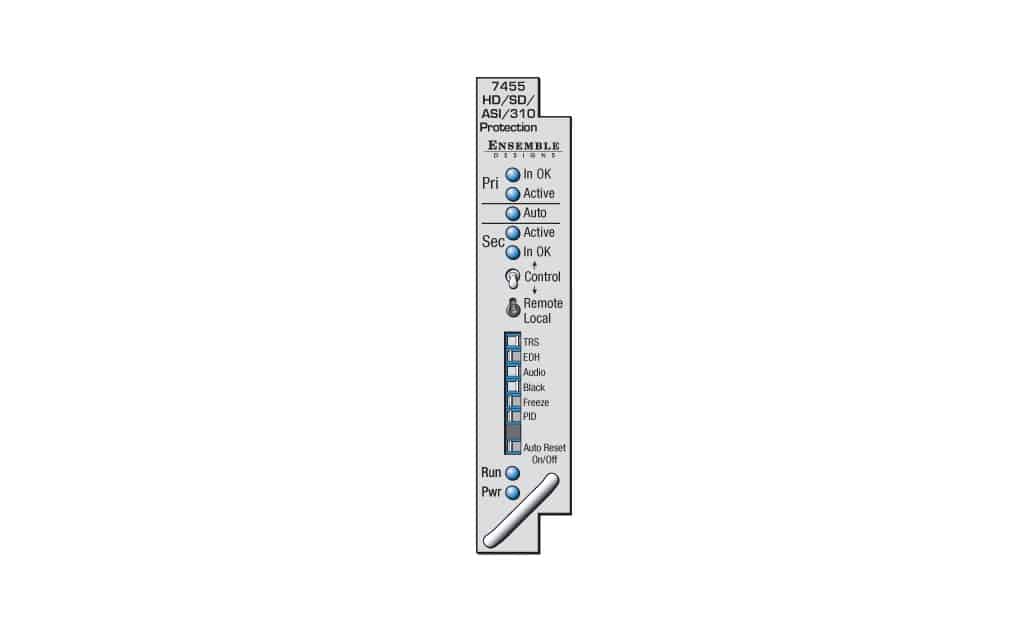
The 7455 module is a fail-safe, bypass protection switch for critical digital paths for broadcast or satellite applications. When a fault is detected in the primary input, and the secondary input is verified as good, the switch will activate, causing the secondary input to be switched to the module’s output. The 7455 includes a passive, fail-safe path that ensures there is an output even in the event of a total power failure. The 7455 supports SD SDI, HD SDI, SMPTE 310M and DVB-ASI signals. Different types of signal testing (vetting) can be enabled on the 7455 and it will apply the tests according to the type of input that is present. This happens automatically and independently for the Primary and Secondary inputs. This means that the Primary input of the module could be HD SDI while the Secondary input is SD SDI. It is also possible to mix SDI, ASI and 310 signals, or receive the same standard on both the Primary and Secondary inputs. The health of a high definition or standard definition video signal is determined by monitoring crucial parameters in order of increasing complexity; Timing Reference Signal (TRS), or a persistent loss of digital sync is tested first. Black, Embedded Audio and Freeze are also evaluated. Each test can be configured by the user. For example, the sophisticated Black Detector includes configurable parameters for black level threshold, pixel count, and duration time. The Freeze detection system can be set to detect a clean or noisy source. Freeze Time sets the number of seconds for the 7455 to switch to the secondary input after a video freeze condition is detected in the primary input. The health of an ASI or 310 signal is determined by monitoring digital clock lock, packet presence, and PID presence. The user can configure tests to define the minimum number of video packets and audio packets expected per second in a given service. The switch can operate in two modes: automatic or nonresetting. In fully automatic mode, the 7455 will automatically switch back to the primary signal once it’s been restored. In the nonresetting mode, the secondary input remains routed to the output, even after the primary input has recovered. The 7455 can be configured locally or controlled and configured remotely with Avenue 5050 Touch Screen, Avenue Tabletop Control Panel, Avenue Express Panel, or Avenue PC Software. Alarm generation, configurable user levels, module lock-out, and customizable menus are just some of the tools included in the Avenue control system.
Avenue 7465 Sync Changeover Switch
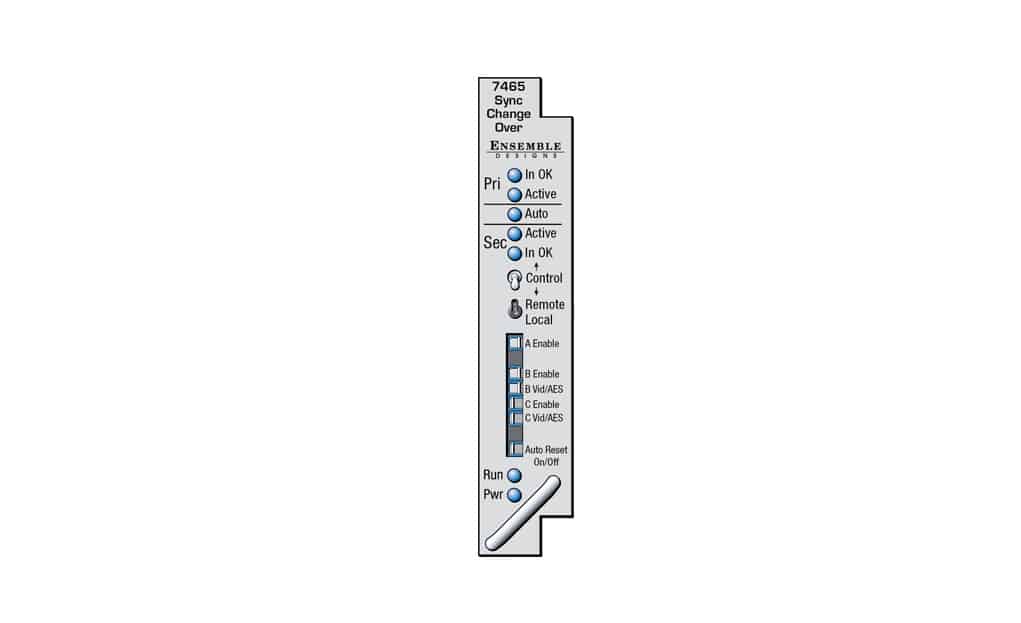
The 7465 Sync Changeover Switch module can be used with Avenue’s 7400 SPG module, or with third party sync pulse generators. In the event of a failure of the primary sync source, the 7465 changes to the secondary source. There are three poles or sections on the 7465. One pole tests for HD SDI and SD SDI signals. The other two poles test for AES audio, Composite video, Bi-Level Sync and Tri-Level Sync. A drop in signal amplitude below a predetermined auto threshold will trigger the switch. Multiple changeover switches can be ganged together through the control system. Depending on the application, two or more 7465s may be required to handle all signals that need to be protected.
Avenue 7550 HD Legalizer
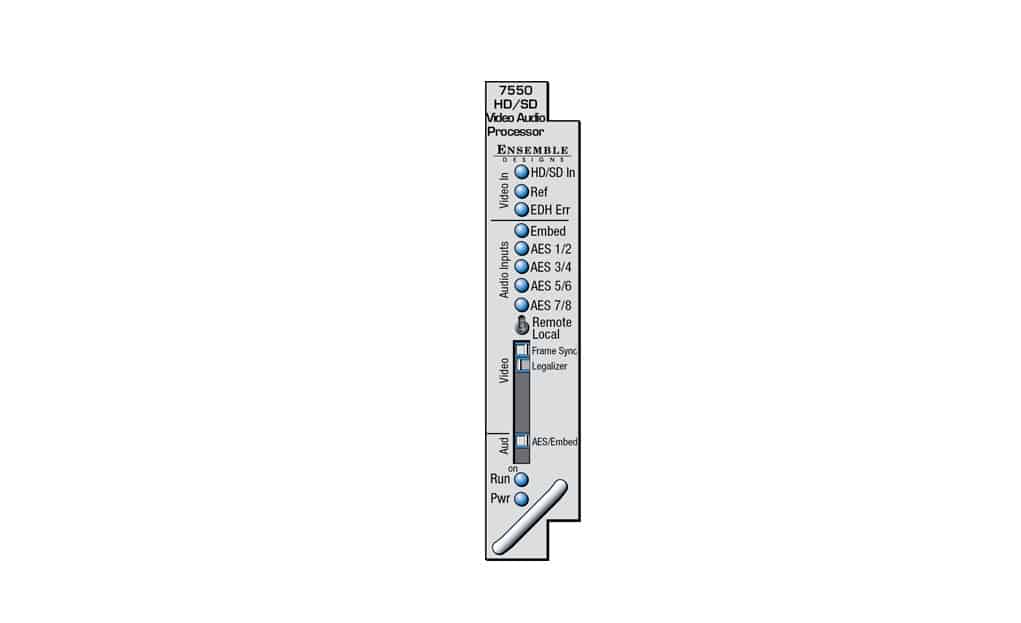
The 7550 module is an HD Legalizer that supports high definition or standard definition digital video. When the Legalizer is enabled, the picture is processed on a pixel by pixel basis to be within legal limits for RGB requirements. Altenatively, the Y, Cr, Cb legalizer provides controls for white clip, and black clip and chroma limiting. Flexible Synchronization An infinitely adjustable timing system genlocks to your house reference. The 7550 genlocks to either composite video (PAL or NTSC) or to Tri-Level Sync. The module can lock to the frame’s master reference or reference can be connected directly to the module’s external reference BNC. The serial output timing can be set anywhere within a frame of the selected input reference, which can be the module’s external BNC reference or the frame’s master timing reference. Upon loss of signal, the 7550 provides freeze frame or black until the signal is recovered. In freeze mode, audio can be muted or passed as desired. Uncompromised Pictures The HD or SD SDI input is carried at full, uncompressed bandwidth throughout the entire module, and EDH monitoring of the digital input alerts you to any incoming problem. EDH detection, monitoring and insertion are standard on the 7550. Flags are reported through Avenue PC. Complete Proc Amp Functions The 7550 has a full-featured Proc Amp for adjustment of every signal parameter. Proc controls include Video and Chroma Gain, NTSC-style hue rotation, Black Balance, and Pedestal. Audio Tracking The 8415 Audio Processing option can be added to the 7550 module. The 8415 is an eight-channel processor that has been designed to provide superior handling of embedded audio. Embedded audio is safely bypassed around the video framestore with the lip sync properly preserved. Total Control Every function and parameter on the 7550 and 8415 can be controlled from an Express Panel, Avenue Touch Panel, or the Avenue PC Control Application. Memory registers can be used to save the complete configuration of the module, making it easy to change instantly between different configurations.
Avenue 7555 HD / SD Video Processing Frame Synchronizer
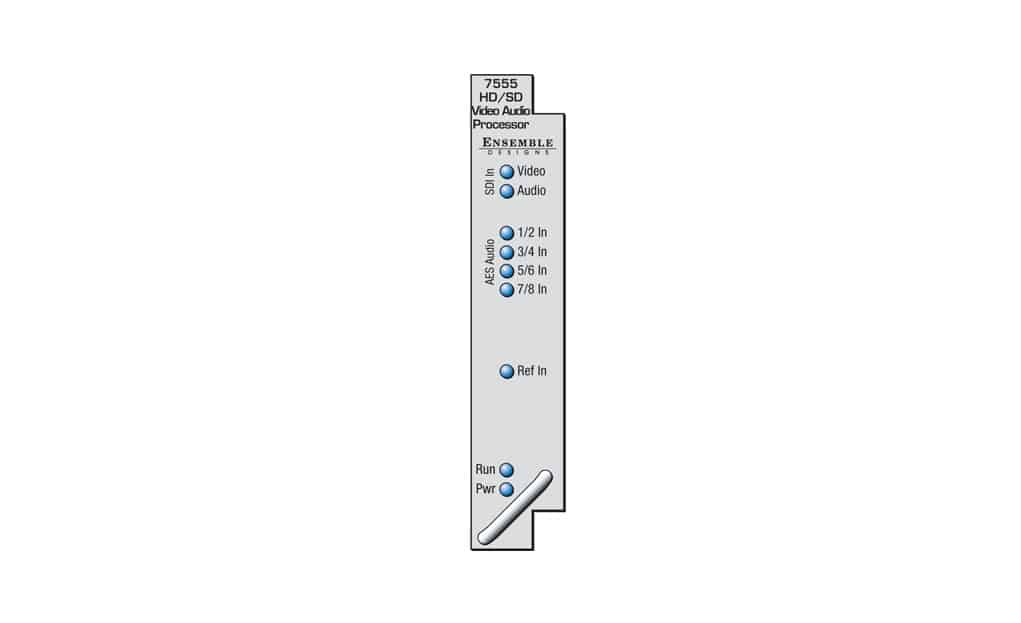
The 7555 HD Processing Frame Sync accepts a 1.5 Gb/s high definition video or standard definition video signal for processing, synchronization and timing. Flexible Synchronization An infinitely adjustable timing system genlocks to your house reference. The 7555 genlocks to either composite video (PAL or NTSC) or to Tri-Level Sync. The module can lock to the frame’s master reference or reference can be connected directly to the module’s external reference BNC. The serial output timing can be set anywhere within a frame of the selected input reference, which can be the module’s external BNC reference or the frame’s master timing reference. Upon loss of signal, the 7555 provides freeze frame or black until the signal is recovered. In freeze mode, audio can be muted or passed as desired. Uncompromised Pictures The HD or SD SDI input is carried at full, uncompressed bandwidth throughout the entire module. Complete Proc Amp Functions The 7555 has a full-featured Proc Amp for adjustment of every signal parameter. Proc controls include Video and Chroma Gain, NTSC-style hue rotation, Black Balance, and Pedestal. Audio Support The 7555 includes a full-featured, sixteen-channel audio mixer. The channel swap and shuffle capability allows you to completely rearrange and remix audio channels. It provides precise control over audio level, with up to 12 dB of gain to compensate for low level sources. Delay is adjustable up to one second. The audio mixer can be used for embedded audio and for audio sourced from the AES or analog inputs. The 9615 AES and analog audio I/O software key option is required if you want to use the AES or analog inputs and outputs. The 9615 provides four AES input/output ports for eight channels of I/O and also provides four channels of analog audio I/O. Dolby and AC-3 The 7555 can be fitted with Dolby™ and AC-3 encoding and decoding options. The 7615 decoding option can be fed from either an AES input or an AES stream disembedded from the incoming SDI signal. The resulting discrete surround signals are then selectable as inputs to the sixteen channel mixer/shuffler. The 7630 Dolby encoder is fed from selected outputs of the sixteen channel mixer/shuffler. The resulting encoded bitstream can be output both on an AES output and embedded into the SDI output. LevelTrack™ AGC and Compliance Options The 9670 LevelTrack™ Audio Automatic Gain Control software key can be added as an option. LevelTrack provides control for keeping audio levels consistent in program material. The 9690 Audio Compliance and Monitoring Software can be added for compliance verification and archiving. Total Control Every function and parameter on the 7555 can be controlled from an Avenue Touch Panel or the Avenue PC Control Application. Memory registers can be used to save the complete configuration of the module, making it easy to change instantly between different configurations. Order Info: 7555HD / SD Video Processor module 7615Dolby E, Dolby D, AC-3 Decoder sub module and software key option Dolby processing options incur 1 frame delay 7630Dolby E Encoder sub module and software key option. Dolby processing options incur 1 frame of delay 9615AES, analog audio, and data I/O software key option 9670Audio Loudness Control AGC software key option 9690Audio Compliance and Monitoring Software
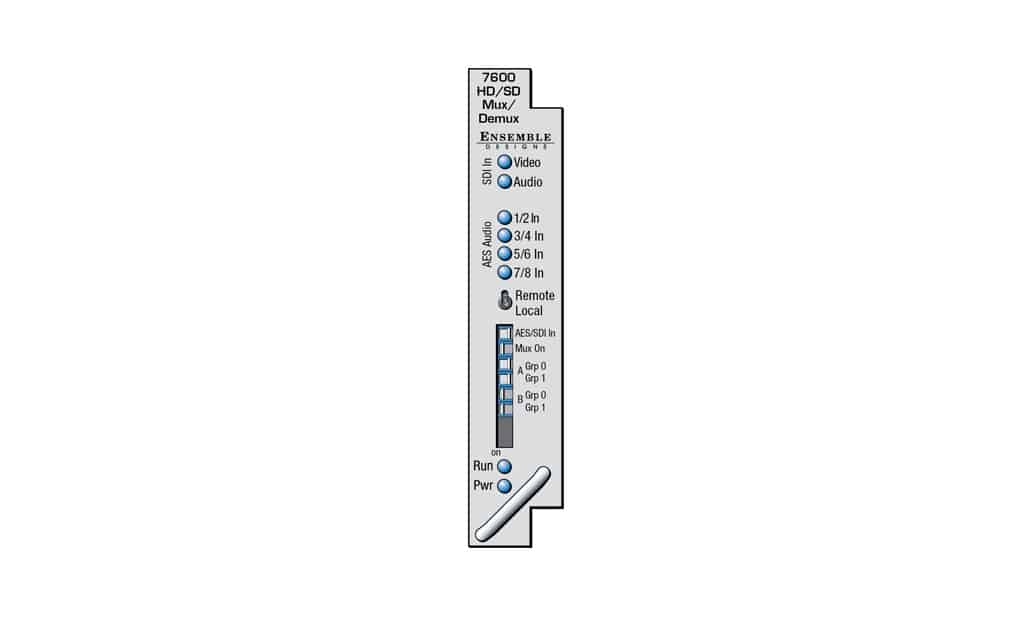
Avenue 7600 HD/SD Embedder/Disembedder
The 7600 module is a dual rate eight-channel audio embedder or disembedder for 1.5 Gb/s high definition video signals or for 270 Mb/s standard definition signals. Four AES ports automatically configure as inputs or outputs depending on if the module is configured as mux or demux. Configurable Mux or Demux When configured as a multiplexer, the 7600 has one serial digital video input and four AES audio inputs. These four AES streams are embedded into the video stream. AES inputs are sample rate-converted, allowing the use of asynchronous audio. The output of the module is a digital stream that contains the original video signal and four AES pairs. When configured as a demultiplexer, audio signals present in the incoming video signal are extracted and delivered as standard AES digital audio streams. The 7600 includes a full-featured, eight-channel audio mixer. The channel swap and shuffle capability allows you to completely rearrange and remix audio channels. It provides precise control over audio level, with up to 12 dB of gain to compensate for low level sources. All audio processing is performed at full 24 bit resolution by a digital signal processor (DSP). Delay is adjustable up to one second. Dolby E decoding is supported by adding the 7615, 7630 or 7635 modules. In-Line Shuffler Because the 7600 has simultaneous disembedding and embedding, it is an in-line processor for embedded audio. It can take embedded content, adjust levels and remap channels, and deliver it to the output as an embedded signal. The 7600 can be configured locally or controlled and configured remotely with Avenue 5050 Touch Screen, Avenue Tabletop Control Panel, Avenue Express Panel, or Avenue PC Software. Alarm generation, configurable user levels, module lock-out, and customizable menus are just some of the tools included in the Avenue control system. Automatic Gain Control Option The 9670 Audio Automatic Gain Control software key can be added as an option. This option provides control for keeping audio levels consistent in program material.
Avenue 7610 8 Channel Audio Processor Sub Module for the 7900 Series (without AES I/O)
The 7610 is an eight-channel sub module for use with the Avenue 7900 Series Up/Down/Cross Converters. It provides processing for signals with embedded audio. No audio I/O is provided. Audio is disembedded, delayed and then reembedded into the video stream. All audio processing is performed at full 24 bit resolution by a digital signal processor (DSP). Lip Sync Preservation The 7610 has been designed to provide superior handling of embedded audio. The disembedder on the input side follows the timing of the video input, even if that input is asynchronous to the house reference. The embedder on the output side is synchronous to house. This allows embedded audio to be safely bypassed around the video framestore with lip sync properly preserved.
Avenue 7615 Dolby™ E, Dolby D and AC-3 Decoder Sub Module and Software Key Option
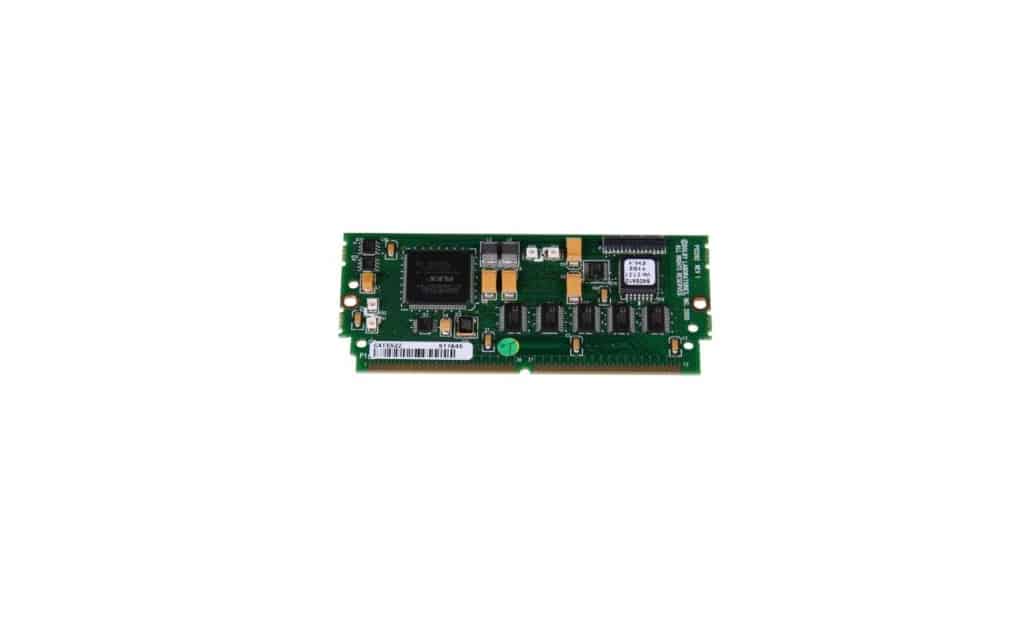
The 7615 Decoder sub module option supports Dolby™ D, Dolby E and AC3 signals. The 7615 fits onto Avenue modules that benefit from comprehensive audio handling. In addition to the hardware sub module, a unique software key is provided for activation. The 7615 decoding option can be fed from either an AES input or an AES stream disembedded from the main module’s incoming SDI signal. The resulting discrete surround signals are then selectable as inputs to the main module’s channel mixer and shuffler. The 7615 is for use with the following modules: • 7555 HD / SD Video Processing Frame Synchronizer • 7660 HD / SD Embedder, Disembedder and Data Inserter • 9550 3G / HD / SD Video Processing Frame Synchronizer • 9600 3G / HD / SD Embedder, Disembedder and Data Inserter For complete audio processing, these modules can be fitted with both the 7615 Decoder and the 7630 Encoder at the same time. One analog audio channel per encoder/decoder is used for data. Both Dolby E and AC3/Dolby D modes are supported.
Avenue 7630 and 7635 Dolby E, Dolby D and AC-3 Encoder Sub Module and Software Key Option
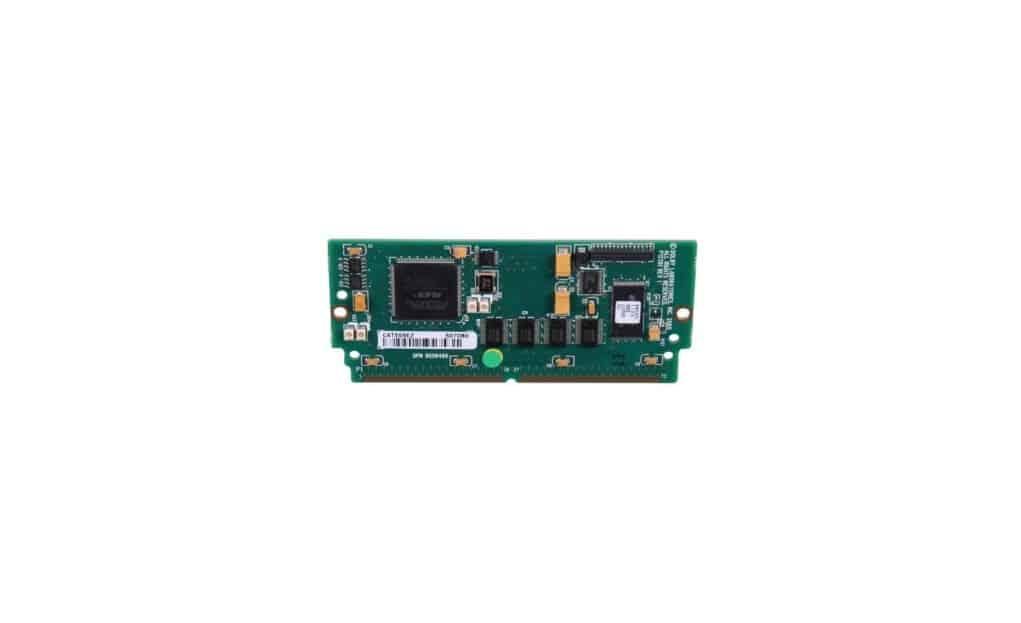
The 7630 Encoder sub module option supports Dolby E signals. The 7635 Encoder sub module option supports Dolby D and AC-3 signals. The 7630 or 7635 fits onto Avenue modules that benefit from comprehensive audio handling. In addition to the hardware sub module, a unique software key is provided for activation. The 7630 or 7635 encoder is fed from selected outputs of the main module’s channel mixer and shuffler. The resulting encoded bitstream can be output both on an AES output and embedded into the SDI output. The 7630 or 7635 are for use with the following modules: • 7555 HD / SD Video Processing Frame Synchronizer • 7660 HD / SD Embedder, Disembedder and Data Inserter • 9550 3G / HD / SD Video Processing Frame Synchronizer • 9600 3G / HD / SD Embedder, Disembedder and Data Inserter The 7555 or 9550 are recommended for use with the 7615, 7630 and 7635 due to the 1 frame delay in the Dolby processors For complete audio processing, these modules can be fitted with both the 7615 Decoder and a 7630 or 7635 Encoder at the same time. One analog audio channel per encoder/decoder is used for data.
Avenue 7660 HD / SD Embedder, Disembedder and Data Inserter
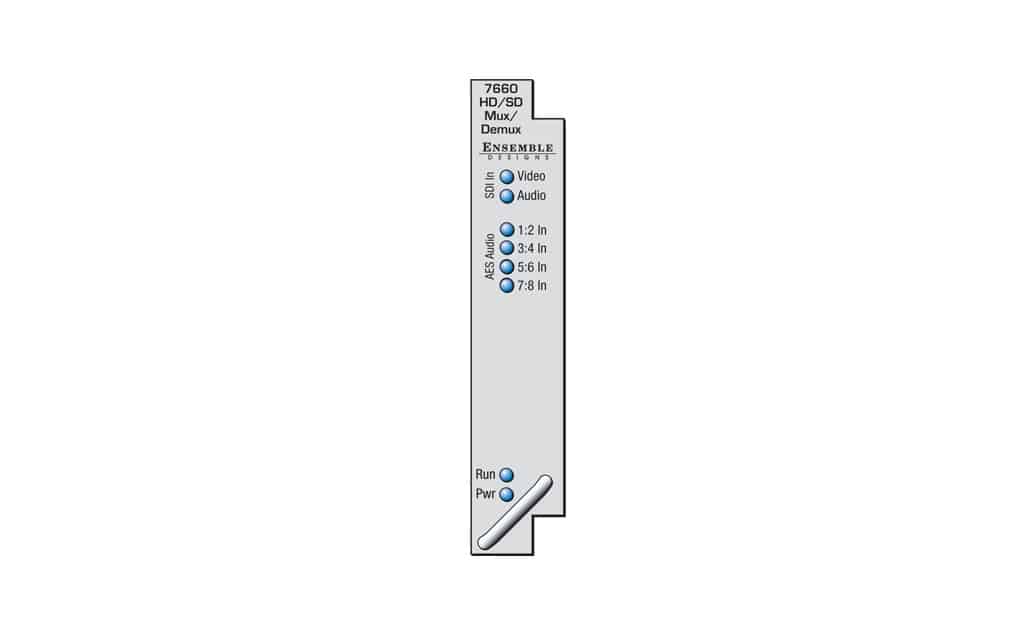
The 7660 module is an eight-channel audio embedder or disembedder for 1.5 high definition or 270 Mb/s standard definition signals. Four AES ports automatically configure as inputs or outputs depending on if the module is configured as mux or demux. Additionally, four channels of analog audio are supported. Configurable Mux or Demux When configured as a multiplexer, the 7660 has one serial digital video input and four AES audio inputs. These four AES streams are embedded into the video stream. AES inputs are sample rate-converted, allowing the use of asynchronous audio. The output of the module is a digital stream that contains the original video signal and four AES pairs, or eight channels. When configured as a demultiplexer, audio signals present in the incoming video signal are extracted and delivered as standard AES digital audio streams. The 7660 includes a full-featured, sixteen-channel audio mixer. The channel swap and shuffle capability allows you to completely rearrange and remix audio channels. It provides precise control over audio level, with up to 12 dB of gain to compensate for low level sources. Delay is adjustable up to one second. In-Line Shuffler Because the 7660 has simultaneous disembedding and embedding, it is an in-line processor for embedded audio. It can take embedded content, adjust levels and remap channels, and deliver it to the output as an embedded signal. Dolby and AC-3 The 7660 can be fitted with Dolby and AC-3 encoding and decoding options. The 7615 decoding option can be fed from either an AES input or an AES stream disembedded from the incoming SDI signal. The resulting discrete surround signals are then selectable as inputs to the sixteen channel mixer/shuffler. The 7630 Dolby encoder is fed from selected outputs of the sixteen channel mixer/shuffler. The resulting encoded bitstream can be output both on an AES output and embedded into the SDI output. Additionally, the 7660 fully supports embedding and disembedding of encoded multi-channel bitstreams such as AC-3 and Dolby E. LevelTrack™ Audio Loudness Control AGC Software and Compliance Options The 9670 LevelTrack Audio Loudness Control AGC software key can be added as an option. LevelTrack provides control for keeping audio levels consistent in program material. The 9690 Audio Compliance and Monitoring Software can be added for compliance verification and archiving. The 7660 can be configured locally or controlled and configured remotely with Avenue 5050 Touch Screen, Avenue Tabletop Control Panel, Avenue Express Panel, or Avenue PC Software. Alarm generation, configurable user levels, module lock-out, and customizable menus are just some of the tools included in the Avenue control system. Order Info: • 7660 HD / SD Embedder, Disembedder and Data Inserter module • 7660-XV HD / SD Embedder, Disembedder and Data Inserter module XV configuration provides 3 SDI outputs • 7615 Dolby E, Dolby D, AC-3 Decoder sub module and software key option. Dolby processing options incur 1 frame of delay • 7630 Dolby E, Dolby D, AC-3 Encoder sub module and software key option. Dolby processing options incur 1 frame of delay • 7635 Dolby D/AC-3 Encoder sub module and software key option. Dolby processing options incur 1 frame of delay • 9670 Audio Automatic Gain Control software key option • 9690 Audio Compliance and Monitoring Software
Avenue 7900 HD Up/Down/Cross Converter
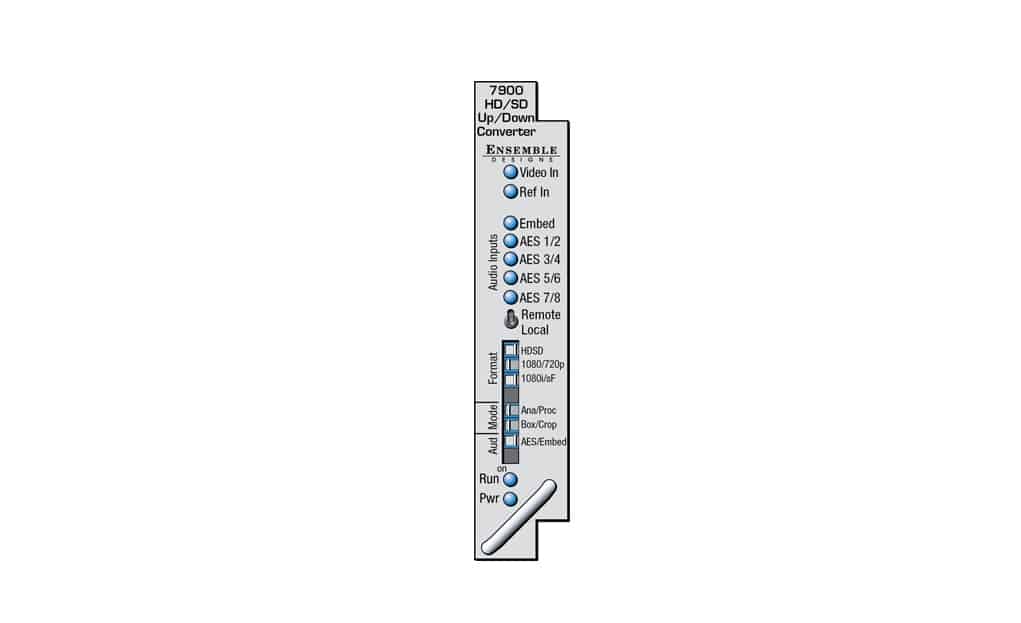
The 7900 is a flexible, configurable Up and Downconverter for use in broadcast and post. It can process SD (Standard Definition) signals into HD, downconvert HD signals into standard definition, and perform Format and Aspect Ratio Conversion on both SD and HD signals. The 7900 and one of the optional audio sub modules together only occupy one slot in an Avenue frame – now that’s efficient use of space. It’s Smart – No Need for Configuration The 7900 can be configured to continually output your facility’s preferred HD format. Just connect any HD or SD signal to the input and the 7900 will convert it to the appropriate format for output. And, if the 8415 audio option is installed, the audio will have automatic delay compensation. Upconversion When configured as an upconverter, the 7900 has a standard definition SDI input and four HD SDI outputs. Excellent for on-air use, the 7900 is equally at home in an HD island, in a signal ingest installation, or in a production application. The 7900 uses sophisticated Edge and Motion Adaptive Noise Reduction, ensuring delivery of a pristine output that is excellent for use in broadcast. All processing is performed on progressive signals at full bandwidth 4:4:4, for optimum signal quality. Signals are interlaced and deinterlaced as required with motion adaption and edge interpolation. Aspect ratio conversion choices include: Letterbox, Anamorphic, Crop and Zoom. Input standard and frame rate are auto-detected. The 7900 automatically performs 16 bit SD and HD color space conversion. The built-in Proc Amp provides adjustment of signal parameters with controls for Video, Chroma, Setup and Hue. Vertical interval data is faithfully preserved and is passed from SD to HD. The upconverted output is timeable with respect to the reference input. Downconversion When used as a downconverter, the 7900 has an HD SDI input and four outputs that can be configured as two SDI and two composite outputs, or four SDI outputs. Whether it’s providing digital feeds to production switchers and routers, or analog monitoring – the 7900 handles it all. The downconversion process includes Picture Detail Enhancement and Anti-Alias Filtering, which makes for a pristine SD output. The Aspect Ratio Conversion process offers Resizing and Repositioning with choices for: Letterbox, Anamorphic, Crop and Zoom. The 7900 automatically adjusts between HD and SD color space and gamma. Proc amp controls are provided in the form of Video, Chroma, Setup and Hue. Both the digital and analog outputs are timeable with respect to the reference input. Cross Conversion The 7900 provides cross conversion between HD 1.5 Gb/s formats, processing all popular variations of 1080 and 720, making it simple for every facility to ingest any type of HD signal. All popular variations of 720p, 1080i, 1080sF and 1080p are supported. The 7900 converts between any HD signals within the 59.94/23.98/29.97 family, within the 50/25 fps family, or within the 60/30 fps family. 3:2 pulldown is used when converting between 59.94 and 23.98. Film mode is automatically detected. Metadata HD closed captioning is carried in data packets in the vertical interval ancillary data space. The 7900 properly translates between HD caption data and traditional SD captioning (line 21 or 23) so that closed captioning content is converted transparently between video standards and formats. Automatic Aspect Ratio Conversion The 7900 supports AFD (Active Format Description) to mark or identify the aspect ratio of the video content. These flags are generated at the output of the module, and they are read at the input. This allows the up and downconversion process to adapt automatically to material that is already in letter or pillarbox form in order to produce the most appropriate conversion. Audio Options When an audio sub module is installed, audio is automatically delayed as needed to compensate for the video processing in the 7900. For complete audio processing, choose from three different audio sub modules. Sub modules plug onto the 7900 board and do not take up a slot in the frame. The 8415 is an eight-channel audio sub module with AES I/O that provides management of embedded audio in the processing path, or supports audio embedding/disembedding alongside the video processing elements. Embedded audio is safely bypassed around the video frame store with the lip sync preserved. Level adjustments and channel shuffling are accessed through the built-in audio mixer. The 9670 Automatic Gain Control option can be added to the 8415. All audio processing is performed at full 24 bit resolution. The 7610 provides carriage of up to eight channels of embedded audio through the format conversion process. Embedded audio in the input signal is delayed to match the video delay and preserve lip sync. The delayed content is reinserted in the video output. No level adjustment or channel swapping is provided. Complete Control System The 7900can be configured locally or controlled and configured remotely with Avenue 5050 Touch Screen, Avenue Tabletop Control Panel, Avenue Express Panel, or Avenue PC Software. Alarm generation, configurable user levels, module lock-out, and customizable menus are just some of the tools included in the Avenue control system.
Avenue 7910 HD Upconverter and Cross Converter
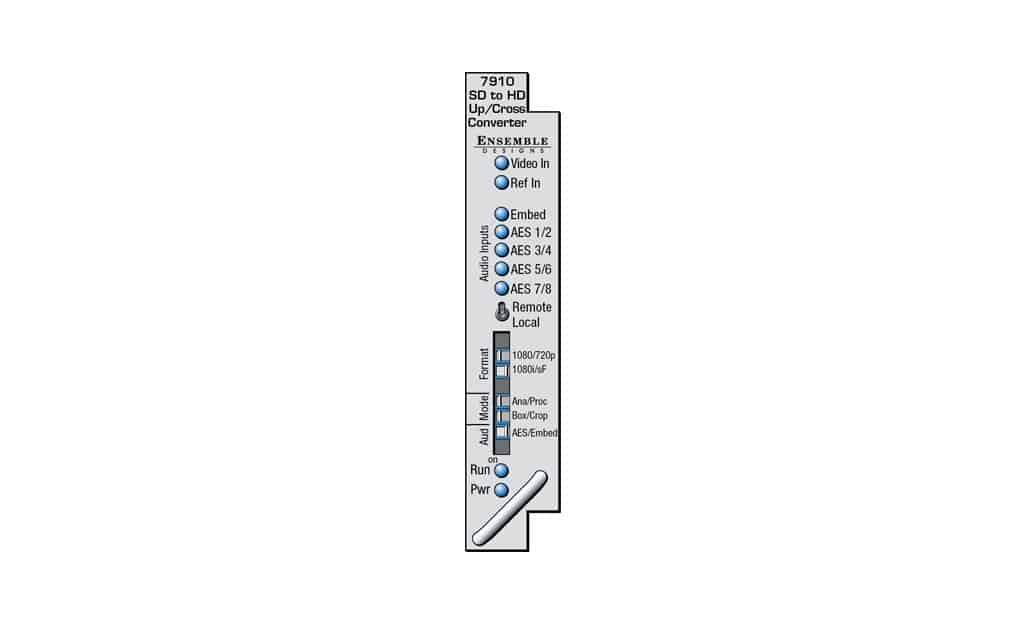
The 7910 module accepts an SD or HD SDI input and has four HD SDI outputs. Excellent for on-air use, the 7910 is equally at home in an HD island, in a signal ingest installation, or in a production application. Since the 7910 functions as either an Upconverter or Cross Converter, it’s useful on the output of a server when material may switch between HD programming and SD commercials. It’s also convenient in a dual-rate master control environment. Sophisticated Adaptive Noise Reduction ensures delivery of a pristine output that is excellent for use in broadcast. Additionally, Picture Detail Enhancement is used to recover information that has been lost due to poor frequency response upstream. Aspect ratio conversion choices include: Letterbox, Anamorphic, Crop and Manual Zoom. Input standard and frame rate are auto-detected. The 7910 automatically adjusts from SD to HD color space and gamma. The built-in Proc Amp provides adjustment of signal parameters with controls for Video, Chroma and Pedestal. The upconverted output is timeable with respect to the reference input. When converting to film rate (1080sF/23.98) formats, 3:2 pulldown cadence is automatically detected and backed out when present in the input. The 7910 can be configured locally or controlled and configured remotely with Avenue 5050 Touch Screen, Avenue Tabletop Control Panel, Avenue Express Panel, or Avenue PC Software. Alarm generation, configurable user levels, module lock-out, and customizable menus are just some of the tools included in the Avenue control system. Metadata HD closed captioning is carried in data packets in the vertical interval ancillary data space. The 7910 properly translates between traditional SD captioning (line 21 or 23) and HD caption data so that closed-captioning content is converted transparently between video standards and formats. Automatic Aspect Ratio Conversion The 7910 supports AFD (Active Format Description) to mark or identify the aspect ratio of the video content. These flags are generated at the output of the module, and they are read at the input. This allows the up and downconversion process to adapt automatically to material that is already in letterbox or pillarbox form in order to produce the most appropriate conversion. Audio Options When an audio sub module is installed, audio is automatically delayed as needed to compensate for the video processing in the 7910. For complete audio processing, choose from three different audio sub modules. Sub modules plug onto the 7910 board and do not take up a slot in the frame. The 8415 is an eight-channel audio sub module with AES I/O that provides management of embedded audio in the processing path, or supports audio embedding/disembedding alongside the video processing elements. Embedded audio is safely bypassed around the video frame store with the lip sync preserved. Level adjustments and channel shuffling are accessed through the built-in audio mixer. The 9670 Automatic Gain Control option can be added to the 8415. All audio processing is performed at full 24 bit resolution. The 7610 provides carriage of up to eight channels of embedded audio through the format conversion process. Embedded audio in the input signal is delayed to match the video delay and preserve lip sync. The delayed content is reinserted in the video output. No level adjustment or channel swapping is provided.
Avenue 7920 HD Downconverter
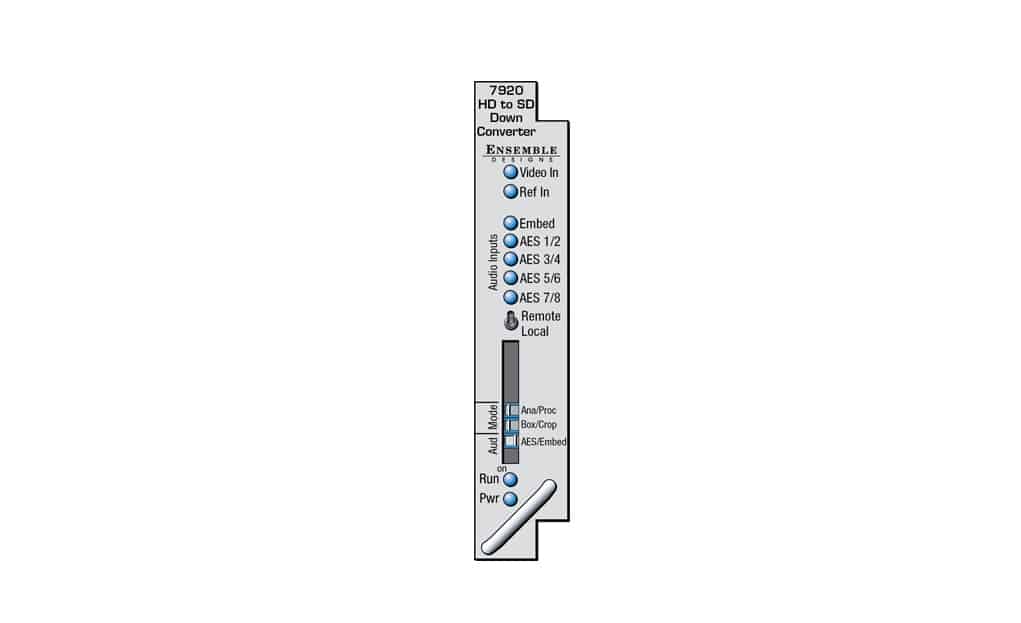
The 7920 module has an HD SDI input and four outputs that can be configured as two SDI and two composite outputs, or four SDI outputs. Whether it’s providing digital feeds to production switchers and routers or analog monitoring, the 7920 is right at home. The Downconversion process includes Picture Detail Enhancement and Anti-Alias Filtering, which make for a pristine SD output. The Aspect Ratio Conversion process offers Resizing and Repositioning with choices for: Letterbox, Anamorphic, Crop and Zoom. The 7920 automatically adjusts from HD to SD color space and gamma. Proc amp controls are provided in the form of Video, Chroma and Pedestal. The 7920 can be configured locally or controlled and configured remotely with Avenue Touch Screens, Express Panels, or Avenue PC Software. Alarm generation, configurable user levels, module lock-out, and customizable menus are just some of the tools included in the Avenue control system. Metadata HD closed captioning is carried in data packets in the vertical interval ancillary data space. The 7920 properly translates between HD caption data and traditional SD captioning (line 21 or 23) so that closed captioning content is converted transparently between video standards and formats. Automatic Aspect Ratio Conversion The 7920 supports AFD (Active Format Description) to mark or identify the aspect ratio of the video content. These flags are generated at the output of the module, and they are read at the input. This allows the up and down conversion proc The 7930 module provides cross conversion between HD 1.5 Gb/s formats, processing all popular variations of 1080 and 720, making it simple for every facility to ingest any type of HD signal. All popular variations of 720p, 1080i, 1080sF and 1080p are supported. The 7930 converts between any HD signals within the 59.94/23.98/29.97 family, within the 50/25 fps family, or within the 60/30 fps family. When converting from 59.94 to 23.98 formats, the 3:2 cadence of any existing film material in the input is automatically detected and backed out. The 7930 can be configured to continually output your facility’s preferred HD format. Just connect any HD signal to the input and the 7930 will cross convert it to the appropriate format for output. And, if the 8415 audio option is installed, the audio will automatically be processed as well. The 7930 can be configured locally or controlled and configured remotely with Avenue 5050 Touch Screen, Avenue Tabletop Control Panel, Avenue Express Panel, or Avenue PC Software. Alarm generation, configurable user levels, module lock-out, and customizable menus are just some of the tools included in the Avenue control system. Metadata HD closed captioning is carried in data packets in the vertical interval ancillary data space. The 7930 converts this caption data transparently between video standards and formats. Automatic Aspect Ratio Conversion The 7930 supports AFD (Active Format Description) to mark or identify the aspect ratio of the video content. These flags are generated at the output of the module, and they are read at the input. This allows the up and downconversion process to adapt automatically to material that is already in letterbox or pillarbox form in order to produce the most appropriate conversion. Audio Options When an audio sub module is installed, audio is automatically delayed as needed to compensate for the video processing in the 7930. For complete audio processing, choose from three different audio sub modules. Sub modules plug onto the 7930 board and do not take up a slot in the frame. The 8415 is an eight-channel audio sub module with AES I/O that provides management of embedded audio in the processing path, or supports audio embedding/disembedding alongside the video processing elements. Embedded audio is safely bypassed around the video frame store with the lip sync preserved. Level adjustments and channel shuffling are accessed through the built-in audio mixer. The 9670 Automatic Gain Control option can be added to the 8415. All audio processing is performed at full 24 bit resolution. The 7610 provides carriage of up to eight channels of embedded audio through the format conversion process. Embedded audio in the input signal is delayed to match the video delay and preserve lip sync. The delayed content is reinserted in the video output. No level adjustment or channel swapping is provided. ess to adapt automatically to material that is already in letterbox or pillarbox form in order to produce the most appropriate conversion. Audio Options When an audio sub module is installed, audio is automatically delayed as needed to compensate for the video processing in the 7920. For complete audio processing, choose from three different audio sub modules. Sub modules plug onto the 7920 board and do not take up a slot in the frame. The 8415 is an eight-channel audio sub module with AES I/O that provides management of embedded audio in the processing path, or supports audio embedding/disembedding alongside the video processing elements. Embedded audio is safely bypassed around the video frame store with the lip sync preserved. Level adjustments and channel shuffling are accessed through the built-in audio mixer. The 9670 Automatic Gain Control option can be added to the 8415. All audio processing is performed at full 24 bit resolution. The 7610 provides carriage of up to eight channels of embedded audio through the format conversion process. Embedded audio in the input signal is delayed to match the video delay and preserve lip sync. The delayed content is reinserted in the video output. No level adjustment or channel swapping is provided.
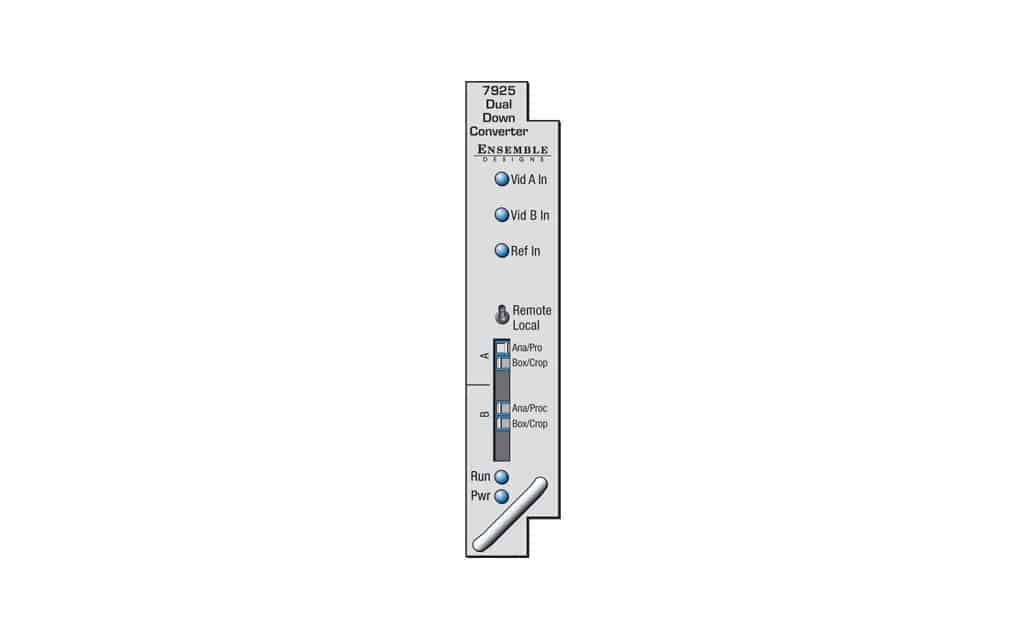
Avenue 7925 Dual HD Downconverter
The 7925 module is a two-channel, dual downconverter with HD and SD outputs that can be used in the most demanding broadcast applications. With two downconverters on one module, the 7925 provides high efficiency with excellent picture quality. The downconverted outputs are timeable with respect to the reference input and can feed production switchers and routers. The 7925 accepts 720p, 1080i, 1080sF and 1080p inputs that are synchronous or asynchronous. If an SD SDI input is received, SD is passed to the output. Motion-adaptive deinterlacing of the video signal enables all internal processing to occur in progressive. The 7925 performs automatic color space and gamma conversion to accommodate the differences between HD and SD. The Aspect Ratio Conversion process offers resizing and repositioning with choices for: Letterbox, Anamorphic, Crop and Zoom. Proc amp controls are provided in the form of Video, Chroma and Pedestal. Video outputs can be timed with respect to the reference input. Audio Handling The 7925 supports 16 channels of embedded audio (without the need for any sub module). Embedded audio in the input is safely bypassed around the video processing, delayed to preserve lip sync, and reembedded in the SD SDI output. Any two of those audio channels can be selected for conversion to analog form. These balanced outputs can be used with the composite video output to feed analog equipment, or for signal monitoring. All audio processing and conversion is performed at full 24 bit resolution. Control The 7925 can be configured locally or controlled and configured remotely with Avenue 5050 Touch Screen, Avenue Tabletop Control Panel, Avenue Express Panel, or Avenue PC Software. Alarm generation, configurable user levels, module lock-out, and customizable menus are just some of the tools included in the Avenue control system. Metadata HD closed captioning is carried in data packets in the vertical interval ancillary data space. The 7925 properly translates HD caption data to traditional SD captioning (line 21 or 23) so that closed captioning content is converted transparently between video standards and formats. Automatic Aspect Ratio Conversion The 7925 uses WSS (Wide Screen Signaling) and AFD (Active Format Description) to mark or identify the aspect ratio of the video content. These flags are read at the input of the module to determine the type of Aspect Ratio Conversion to perform. Subsequently, these flags are properly updated in the output signal to reflect its format and presentation.
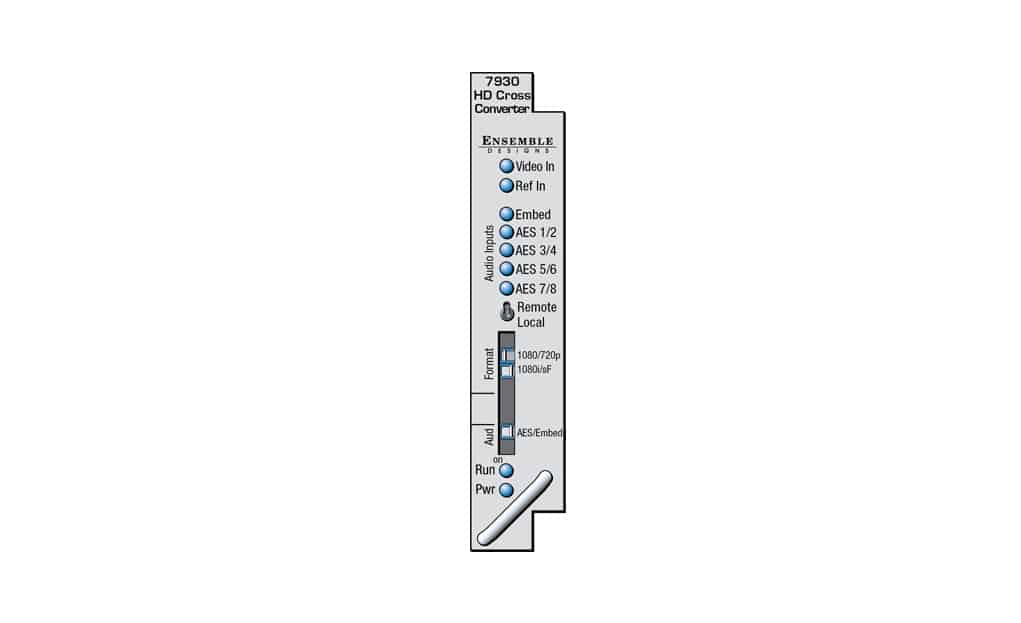
Avenue 7930 HD Cross Converter
The 7930 module provides cross conversion between HD 1.5 Gb/s formats, processing all popular variations of 1080 and 720, making it simple for every facility to ingest any type of HD signal. All popular variations of 720p, 1080i, 1080sF and 1080p are supported. The 7930 converts between any HD signals within the 59.94/23.98/29.97 family, within the 50/25 fps family, or within the 60/30 fps family. When converting from 59.94 to 23.98 formats, the 3:2 cadence of any existing film material in the input is automatically detected and backed out. The 7930 can be configured to continually output your facility’s preferred HD format. Just connect any HD signal to the input and the 7930 will cross convert it to the appropriate format for output. And, if the 8415 audio option is installed, the audio will automatically be processed as well. The 7930 can be configured locally or controlled and configured remotely with Avenue 5050 Touch Screen, Avenue Tabletop Control Panel, Avenue Express Panel, or Avenue PC Software. Alarm generation, configurable user levels, module lock-out, and customizable menus are just some of the tools included in the Avenue control system. Metadata HD closed captioning is carried in data packets in the vertical interval ancillary data space. The 7930 converts this caption data transparently between video standards and formats. Automatic Aspect Ratio Conversion The 7930 supports AFD (Active Format Description) to mark or identify the aspect ratio of the video content. These flags are generated at the output of the module, and they are read at the input. This allows the up and downconversion process to adapt automatically to material that is already in letterbox or pillarbox form in order to produce the most appropriate conversion. Audio Options When an audio sub module is installed, audio is automatically delayed as needed to compensate for the video processing in the 7930. For complete audio processing, choose from three different audio sub modules. Sub modules plug onto the 7930 board and do not take up a slot in the frame. The 8415 is an eight-channel audio sub module with AES I/O that provides management of embedded audio in the processing path, or supports audio embedding/disembedding alongside the video processing elements. Embedded audio is safely bypassed around the video frame store with the lip sync preserved. Level adjustments and channel shuffling are accessed through the built-in audio mixer. The 9670 Automatic Gain Control option can be added to the 8415. All audio processing is performed at full 24 bit resolution. The 7610 provides carriage of up to eight channels of embedded audio through the format conversion process. Embedded audio in the input signal is delayed to match the video delay and preserve lip sync. The delayed content is reinserted in the video output. No level adjustment or channel swapping is provided.

Looking for something else?

I.M.D.P.
Monitors
Timing
Calibration
Viewfinders

International

  • Plura Europe GmbH Germany
  • Plura MEA Dubai – UAE
  • Plura ASIA Seoul – S. Korea

The Americas

  • Arizona Plura Broadcast, Inc. HQ

Stay in touch for news on the latest in product development

Copyright © 2026 Plura Inc. All Rights Reserved.