• Skip to main content
  • Why Plura
    • Our Team
    • Videos
    • 15th Anniv.
    • Our History
    • Case Studies
    • Distributors
  • Products
    • At a Glance
    • X Processing
    • I.M.D.P.
    • Monitors
    • Timing
    • Calibration
    • Viewfinders
  • Support +
    • Downloads
    • Virtual Mtg.
    • RMA Request
  • News & Events
    • News
    • Events
  • Contact
  • Why Plura
    • Our Team
    • Videos
    • 15th Anniv.
    • Our History
    • Case Studies
    • Distributors
  • Products
    • At a Glance
    • X Processing
    • I.M.D.P.
    • Monitors
    • Timing
    • Calibration
    • Viewfinders
  • Support +
    • Downloads
    • Virtual Mtg.
    • RMA Request
  • News & Events
    • News
    • Events
  • Contact
Signal Processing
I.M.D.P.
Monitors
Timing
Calibration
Viewfinders
Home  //  Signal Processing  //  Avenue  //  Avenue PC Control
avenue_pc-gui-1021x623avenue_pc-gui-1021x623
  • Avenue PC Control

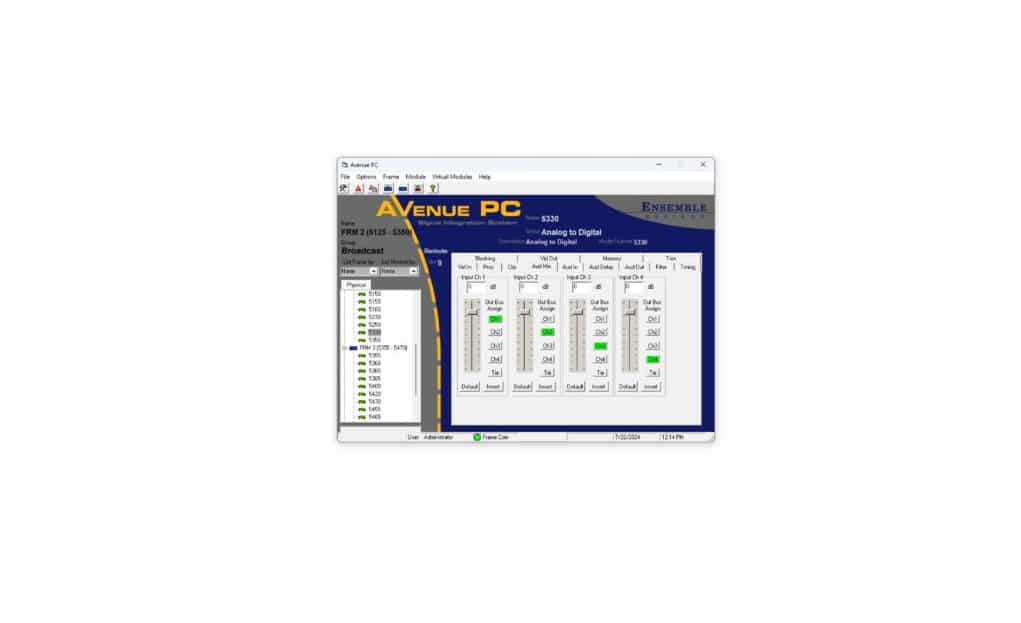
    Avenue’s control system gives you complete control of your video and audio signals. Module configuration is straight-forward and intuitive. Along with Touch Screen and Express Panel control, you can also access and control all frames and modules in the Avenue system with Avenue PC Control Software. The Avenue PC application comes on CD or can be downloaded from the Ensemble website.

    The Avenue PC Control Application Software option is a PC-based remote control application which allows you to completely control, configure and monitor the modules in each of your Avenue frames. Avenue PC can be installed on a PC running all Windows operating systems. PC interface to the Avenue frames can be made through an RS-232 serial connection or through Ethernet.

    Your PC can be connected to one of the Avenue frames (1RU, 3RU, or Intersection Frame) through a PC serial port or via Ethernet on the back of the Avenue frames. When Avenue frames are connected via IP or AveNet, Avenue PC only needs to connect to a single frame to access the entire Avenue System. Regardless of the network topology, Avenue PC will have visibility and control over all of the modules.

    Module Control

    The Module Selection screen is illustrated at right. Available frames on the Avenue network will appear in the window. Expanding each frame will show the Avenue modules present in each frame.

    As shown in the List Frame illustration at right, the frames can be listed by Name, Group and Address ID. The modules can be listed by Name, Group, Slot, Model, and Type.

    When you select a module from the list the setup menus available for that particular module will be displayed. Also displayed on the Mainscreen above the menus will be the Name and Description of the module, the Group, the Module number and whether the module is set to Remote or Local and if the module is Locked or Unlocked. Make sure the front panel switch on the module is set to Remote to allow it to be controlled by Avenue PC.

    Updating Avenue PC and Module Software

    The latest Avenue PC and Avenue Module software can be from the support section.

    Alarms

    Avenue PC gives you the ability to set alarms on a frame or module basis. You can define Low and High Alarms and then set conditions on a frame or module to react with the defined alarms.

    Low and High Alarms

    The control data from each frame module can be used to alert you when a module indicator becomes active or a module is missing. There are two alarm conditions, Low and High. You may define both types of alarms, making one a higher priority than the other or setting up a higher priority condition in one type of alarm.

    Each alarm condition allows you to define the characteristics that will alert you when a module condition changes. Some of the alarm types include Visual Blinking and Audio which allows your PC to sound a Beep or Red Alert. You can also set up an alarm to send an email or page.

    Logging Alarms

    The Alarms pull-down brings up the Alarms definition menu. To add an alarm, click on the Add Alarm box to bring up the Conditions entry screen. You can select the frame, then the module and choose the control data for the alarm given. You may also enable or disable the alarm with the Enable check box in the Conditions screen.

    You can lock modules on Avenue PC and set Module User Levels. Modules in the Avenue system running v2.0 software or later have a User Level assigned to each adjustable control parameter. These levels are assigned to a default according to the type of adjustment. The User Levels of these parameters can be edited by an Administrator if desired using this menu.

    Set User Levels

    To edit Control User Levels, select an Avenue module from the frame list so its control parameters appear in the Edit Control User Level window. Select the individual Control in the list, then click on the User Level desired for this Control parameter. Select Done when finished to save and close the list.

    Save and Load Module Configurations

    Save Module Configuration: This menu allows you to save a module configuration to a file. All module parameters will be stored and this file may be saved or downloaded to another module of the same type.

    Load Module Configuration: Selecting this function brings up a file location menu. The configuration from a stored file can be downloaded to another module of the same type.

    Virtual Modules

    Virtual Modules are custom menus that combine functionality from any modules in the system. Use the Virtual Modules menu to create the combinations of controls from any modules. Virtual modules allow you to customize a module’s menu to meet your facility’s needs.

    Product Documents

    Manuals

    • Avenue System Overview
    • Avenue PC Manual 2.0.8

    Software

    • Avenue PC 2.0.21
    Contact Sales
    • Highlights
    • Specifications
    • Product Downloads

    Description

    • Control and monitor all modules in the system from one or many locations
    • Easily adjust video levels, timing, audio delay and other parameters
    • Store module configurations to another module of the same type
    • Set user-defined alarms to alert you at any time when a fault condition has occurred and to maintain logs. Set email and pager alerts.
    • Download new module software – free for the life of the product!
    • Define access to each module parameter based on User Levels
    • Define security User Levels protected by pass codes for locking out module changes on critical paths
    • Customize module menus by creating “Virtual Modules,” custom groups of menus that combine functionality from any modules in the system
    Additional information

    Control

    Ethernet, RS232

    Product Documents

    Manuals

    • Avenue System Overview
    • Avenue PC Manual 2.0.8

    Software

    • Avenue PC 2.0.21

    Related products you might be interested in

    BEM-1-H, BrightEye Mitto 3G, 3G/HD/SD Scan Converter w/HDCP SupportUse BrightEye Mitto™ BEM-1-H to deliver DVI, HDMI, and VGA sources to 3G, HD and SD SDI video resolutions. Ensemble Designs’ proprietary scaling and filtering technology ensures that Mitto always produces a pristine, detailed video output. Even the most demanding CGI material is faithfully rendered to television. YouTube, Zoom, Tik-Tok, and Everything Else Made Easy Take just about any source to 3G, HD or SD SDI video. Computer video can now be used for the most demanding applications including broadcast, high-end military, medical, classroom, church and corporate. Just a small part of the screen, such as a Tik-Tok video, can be selected with a mouse and converted to full screen HD. Mitto delivers the best looking video – compare Mitto to any other scan converter and see the difference! HDCP is not a Problem Many systems now require HDCP for video playback, regardless of content licensing. BEM-2-H can handle HDCP encrypted content with the added BEM-HDCP option. Muting Disable available with the purchase of option BEM-HDCP license and signed waiver. BrightEye Control Software Using BrightEye control software, you can easily time BrightEye Mitto into a video production switcher or router. From your desktop, you have complete and intuitive control of video format, video levels, output timing, mixing audio channels, and audio delay. Pristine, Detailed Video Output A superior quality scan converter, BrightEye Mitto has the advantage of proprietary scaling technology and exclusive multi-tap filtering. Even a small part of the computer screen, such as a YouTube video, will be upconverted to full screen HD. The region selected for output determines if Mitto acts as an up converter or downconverter. The output looks as good, or better, than the original and passes the most stringent testing. Easy To Use Use the Selection Tool in BrightEye Control to select what portion of the screen you want to output. The Selection Tool floats over the content on your display, showing the portion of the video that will be output from BrightEye Mitto. Use Your Mouse To Select What is Output to Video Use your mouse to click and drag over the specific portion of computer video that you want to output. The perspective of seeing the whole screen relative to your selection gives you the ability to choose exactly which portion of the video you want to scan convert for output. Resize the selection window by clicking and dragging with your mouse. Mitto’s video output automatically goes to pillarbox or letterbox as needed. Mitto automatically maintains perfect aspect ratio. Digital and Analog Video and Audio The intuitive front panel interface makes it easy to choose the desired video output format. The genlock reference input allows the video outputs to be timed to house. Audio can be input through the DVI (or HDMI with adapter) input, or the 3.5mm audio input. The audio input accepts analog audio or AES digital audio. Audio is embedded into the SDI outputs – which is required for many high end applications. Audio delay controls let you adjust the audio timing with respect to video for perfect lip sync, which is crucial when using Zoom, Google Meet, or Microsoft Teams video in a production environment.
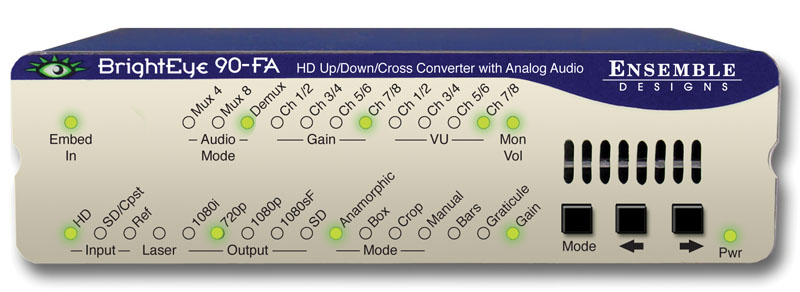
    BrightEye 90-FA HD Up/Down Cross Converter and ARC with Analog Audio and Optical OutputBrightEye 90-FA is a versatile up/down/cross converter or aspect ratio converter for use with analog and digital video signals with the addition of an optical output. Optical connectivity allows for long cable runs between buildings or in mobile applications. Simply set the BrightEye 90-FA to output your facility’s preferred HD or SD standard. The BrightEye 90-FA will accommodate whatever input you connect analog composite, SD SDI or HD SDI. After setting the output standard, BrightEye 90-FA automatically converts the selected input to the correct standard for your facility. BrightEye 90-FA will upconvert, downconvert, cross convert, or act as an ARC, as needed. The built-in Frame Synchronizer allows you to feed asynchronous signals to the BrightEye 90-FA. An external reference input allows genlock to a house reference. All vertical interval data and closed captioning is faithfully passed. Upconverting to High Definition Feed the analog composite or SD SDI output of a camera to a BrightEye 90-FA and upconvert to HD. You can take the HD signal from the BrightEye 90-FA into a switcher or projection system. Upconverting existing SD equipment lets you leverage the equipment you already have and operate in the HD domain. While some cameras may have firewire out, using the video output and upconverting before distribution is preferable since longer cable runs can be achieved and quality is superior. Additionally, the BrightEye 90-FA’s reference input allows you to time the upconverted video output for use with a production switcher. Downconverting to Standard Definition BrightEye 90-FA will downconvert any type of HD signal and provides both an SD SDI and an analog composite output suitable for broadcast or monitoring. Cross Conversion It’s easy to convert between various HD standards, whether 720p or 1080i. Simply select the output standard you need and connect the input, that’s all there is to it. Aspect Ratio Conversion For converting between SD 4:3 and HD 16:9, BrightEye 90-FA has you covered. Just select the output standard you need and connect the input. Audio Processing Made Simple BrightEye 90-FA handles both embedded audio and eight channels of analog audio. Sixteen channels of embedded audio are supported in BrightEye 90-FA. If the incoming video has embedded audio, the audio will be safely bypassed around the video processing and lipsync will be preserved. Audio mixing is available for two of the four embedded groups of audio. The analog audio I/O ports can be configured for eight channels of incoming audio or for eight channels of audio output. The audio mixer can be used for analog audio as well. Mixer controls are accessed through the BrightEye Control app. Monitoring for Video and Audio Audio monitoring is easy with BrightEye 90-FA’s convenient 3.5mm mini jack. Select the audio channels you want to monitor from the front panel and plug in a headset. The HDMI connector on the rear of the unit provides a future proof monitoring interface. Plug it into most LCD monitors for confidence monitoring of your feed. Front Panel and Software Control Input selection, gain control, and test patterns control are provided through the front panel interface. Audio presence LEDs indicate which channels are detected. Controls for crop, letterbox and pillarbox are accessed from the front panel or the BrightEye Control software. Video and audio levels and the audio mixer can be adjusted through BrightEye Control.
    BrightEye 30-D Audio ADC and DAC Bi-directional Converter with DelayBrightEye 30-D is a flexible audio converter that can be a two channel, bi-directional ADC and DAC, or it can be configured as a four channel converter. Perfect in desktop, post and broadcast applications, 24 bit processing ensures beautiful audio. As a bi-directional converter, two channels of analog audio are converted to AES digital audio and at the same time an AES stream is converted to two channels of analog. Alternately, the unit can be configured as a four channel AES to analog converter or a four channel analog to AES converter. BrightEye 30-D also serves as a sample rate converter. For example, a digital 44.1 KHz signal from a CD player can be fed to the input and a digital AES3id, 48 KHz signal synchronous to the reference input will be output. Audio mixing, level adjustments, channel shuffling and delay are accessed through the BrightEye Control app. Audio delay adjustments simplify signal integration. A variety of audio connectors and adapters are available for integrating BrightEye 30-D to any type of system. A reference input is provided which allows digital outputs to be synchronized to either a PAL or NTSC video signal or AES reference.
    BrightEye NXT 950 4 Channel SDI Frame Sync & U/D/CThe BrightEye NXT 950 Frame Synchronizer packs a lot of features in a tiny package. Frame Synchronization and Format Conversion, with 16 channels of embedded Audio. The NXT 950 has four independent frame synchronizers. Each supports automatic input format detection and conversion to desired output format. Adjust video and chroma gains with the built-in Proc Amp. Color Correct to compensate for input material or to match projectors and monitors. Adjust levels and swap/mix channels in Embedded Audio. Even embedded surround sound (Dolby, AC-3) is synchronized from input to output. Control the Frame Syncs and monitor each channel’s input and output from the front panel, or through the interactive Web interface. Rackmount up to three NXT 950s in 1RU for the ultimate processing density.

    Looking for something else?

    Signal Processing
    I.M.D.P.
    Monitors
    Timing
    Calibration
    Viewfinders

    Contact Sales

    International

    • Plura Europe GmbH Germany
    • Plura MEA Dubai – UAE
    • Plura ASIA Seoul – S. Korea

    The Americas

    • Arizona Plura Broadcast, Inc. HQ

    Stay in touch for news on the latest in product development

    Copyright © 2026 Plura Inc. All Rights Reserved.