• Skip to main content
  • Why Plura
    • Our Team
    • Videos
    • 15th Anniv.
    • Our History
    • Case Studies
    • Distributors
  • Products
    • At a Glance
    • X Processing
    • I.M.D.P.
    • Monitors
    • Timing
    • Calibration
    • Viewfinders
  • Support +
    • Downloads
    • Virtual Mtg.
    • RMA Request
  • News & Events
    • News
    • Events
  • Contact
  • Why Plura
    • Our Team
    • Videos
    • 15th Anniv.
    • Our History
    • Case Studies
    • Distributors
  • Products
    • At a Glance
    • X Processing
    • I.M.D.P.
    • Monitors
    • Timing
    • Calibration
    • Viewfinders
  • Support +
    • Downloads
    • Virtual Mtg.
    • RMA Request
  • News & Events
    • News
    • Events
  • Contact
Signal Processing
I.M.D.P.
Monitors
Timing
Calibration
Viewfinders
Home  //  Signal Processing  //  Avenue  //  Avenue 8500 Composite / SD Legalizer and Video Processing Frame Sync
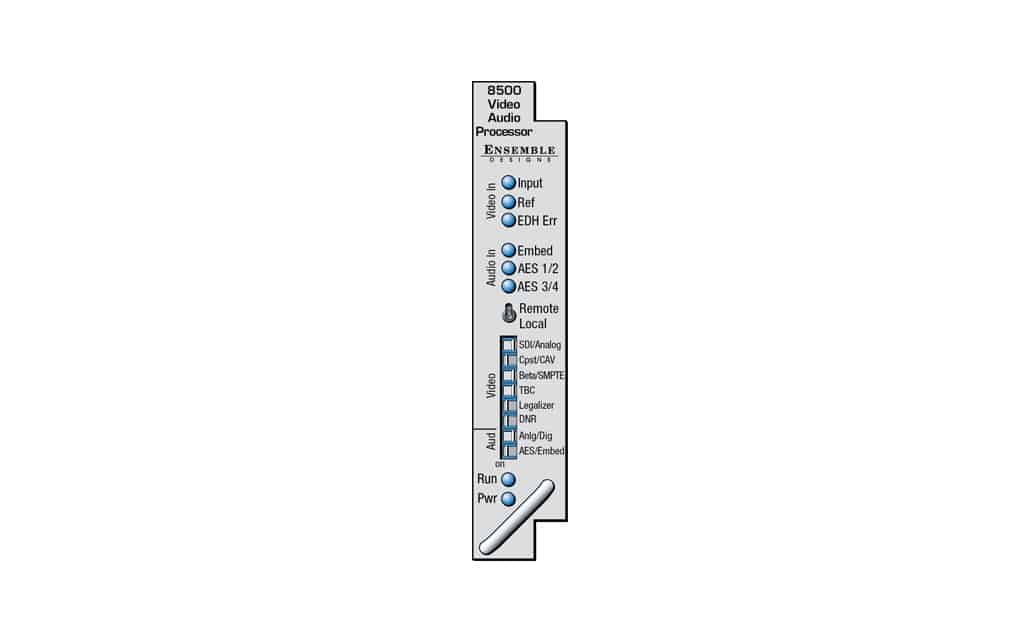
avenue_8500_front-1021x623avenue_8500_front-1021x623
  • Avenue 8500 Composite / SD Legalizer and Video Processing Frame Sync

    The 8500 module is a composite Legalizer, Proc Amp, TBC and Frame Sync. The Legalizer is a predictive clipper which insures signal levels will not exceed those permitted in the composite domain. While the Legal setting automatically puts in values to insure signals will not exceed composite legal limits, selecting Custom allows the you to set a range of clip values.

    Noise Reducer Option

    The optional 8520 Noise Reducer removes unwanted noise and artifacts with is motion- and scene-adaptive filtering. Several forms of noise reduction are employed to ensure the best possible performance. Recursive Temporal Noise filtering includes Simple Recursive, Motion Adaptive and Motion Adaptive with Impulse Filters. Controls are provided for maximum signal-to-noise improvement and for noise threshold. These can be set manually or run in automatic mode. The combination of the 8500 module and the 8520 noise reducer is perfect for MPEG compression preprocessing and satellite or ENG feeds.

    Uncompromised Pictures

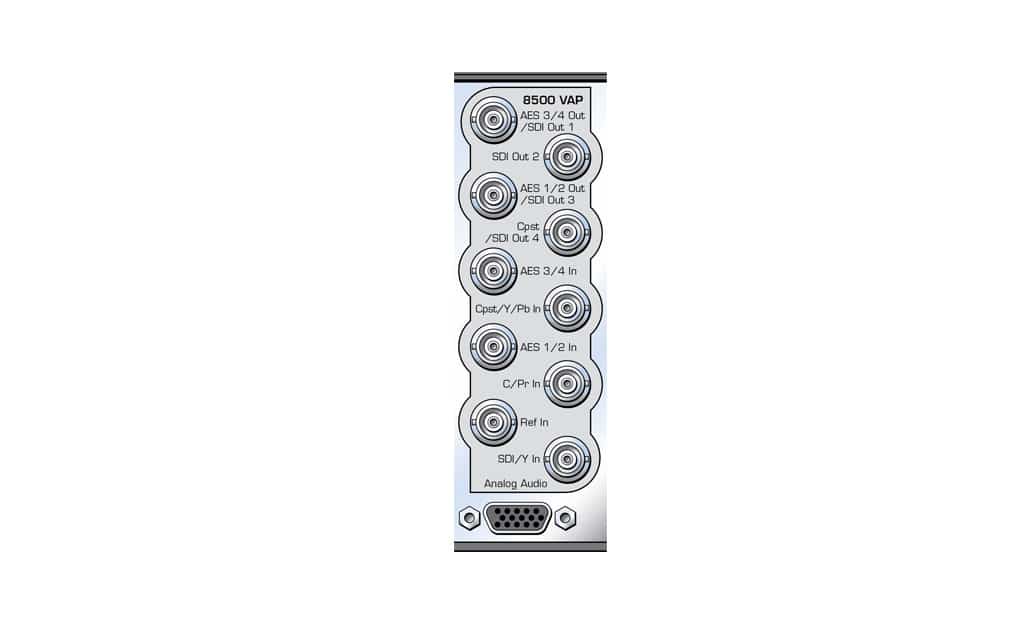
    Whether your input is standard definition SDI Digital Component, Analog Composite or Analog Component, the 8500 handles it with precision and accuracy. The SDI input is carried at full uncompressed bandwidth throughout the entire module, and EDH monitoring of the digital input alerts you to any incoming problem. Analog inputs are 4x oversampled at 12 bits of resolution. Composite signals are decoded using an adaptive comb filter. Complete control over signal levels is provided.

    Digital and Analog Outputs

    With both SD SDI and 12 bit analog inputs (composite, component, or S-Video [Y/C] formats), the 8500 is easily integrated into any hybrid facility. The 8500 simultaneously outputs both SDI digital component and 12 bit analog composite.
    Outputs are fully timed to your house reference, including the subcarrier and ScH phase of the composite output. The analog output is constructed at 8 x oversampling with 12 bits of quantizing resolution. On loss of input, the output can mute to black or freeze on the last good frame of video.

    Rock Steady TBC/Frame Synchronizer

    Input video is synchronized to your house reference by an agile TBC/Frame Synchronizer. Even noisy and jittery analog sources are faithfully tracked to provide a steady, genlocked output. Robust signal handling ensures proper time base correction for virtually any source, even a consumer VHS machine. Select the SDI input and the 8500 is a serial digital frame sync.

    Complete Proc Amp Functions

    The 8500 has a full-featured Proc Amp for adjustment of every signal parameter. Proc controls include Video and Chroma Gain, NTSC-style hue rotation, Black Balance, and pedestal. Black and White clips can be set to prevent excessive signal excursions.

    A Detail Enhancer recovers information that has been lost due to poor frequency response in upstream systems. Certain values represented in serial digital component may be illegal in the PAL or NTSC composite domains. The Predictive Composite Clipper mode identifies picture elements that would be illegal in analog composite, and limits color saturation and luminance excursions. You can be confident that the work you’re doing in digital component will look its best in composite.

    Selective (toothed) vertical blanking lets you choose to pass or strip content in the vertical interval on a line-by-line and field-by-field basis. To help optimize the settings in the Proc Amp, a Split Screen mode allows you to compare the processed output with the original material.

    Audio Options

    A four or eight channel audio sub module can be added to the main 8500 module. Either the 8415 or 8510 can be added to accommodate audio I/O, channel shuffling and mixing. The 8500 module passes embedded audio and Dolby without an audio sub module.

    Total Control

    Because the 8500 is an Avenue module, every function and parameter can be controlled from the Avenue Control System. Memory registers can be used to save the complete configuration of the module, making it easy to change instantly between different configurations. Any combination of Express Panels, Touch Screens and PCs can be used to control the 8500. The Express Panel is especially well suited for use with the 8500.

    Product Documents

    Datasheet

    • 8500 Data Sheet

    Manual

    • 8500 Module Manual

    SNMP

    • 8500 & 8400 SNMP

    Firmware

    • 8500 Firmware v2.2.13
    Contact Sales
    • Highlights
    • Specifications
    • Product Downloads

    Description

    • Video Legalizer
    • Predictive Composite Clipper
    • Black and White clips
    • Excellent tracking of noisy inputs
    • Adaptive Comb Filter decoder, sharpness filter
    • Split Screen mode
    • Outputs are fully timeable
    • Composite, component, S-Video input
    • A to D, and D to A, all in one module
    • Full-featured TBC/Frame Synchronizer
    • Comprehensive Proc Amp controls
    • Passes embedded audio and Dolby
    • 12 bit, 8 x Oversampled analog output
    • 4x oversampled analog input
    • SD SDI (Serial Digital) input
    • Simultaneous SD SDI and analog composite outputs
    • Line-Selectable toothed blanking
    • Internal color bar generator
    • Memory Registers
    • 4- or 8-channel audio options
    • Noise Reducer option

    Additional information

    Control

    Ethernet, RS232, GPIO, SNMP, AveNet

    Video Input

    SD SDI, Analog Component, Analog Composite

    Video Output

    SD SDI, Analog Composite

    Video Processing

    Reference In/Timeable Output, TBC/Frame Sync

    Product Documents

    Datasheet

    • 8500 Data Sheet

    Manual

    • 8500 Module Manual

    SNMP

    • 8500 & 8400 SNMP

    Firmware

    • 8500 Firmware v2.2.13

    Related products you might be interested in

    BrightEye 24 SDI to Analog Converter and DisembedderBrightEye 24 is both a disembedder (demultiplexer) and a digital to analog video converter. The incoming serial digital video signal is converted to an analog composite output. Audio signals present in the incoming digital video signal are extracted and delivered as four channels of analog audio. Audio mixing, level adjustments, and channel shuffling are accessed through the BrightEye Control app. Audio group selection is also made through BrightEye Control. A variety of audio connectors and adapters are available for integrating BrightEye 24 to any type of system. Use BrightEye 24 in desktop and broadcast applications.
    BrightEye 55 Genlockable Sync Generator and Test Signal GeneratorBrightEye 55 is a genlockable sync generator and test signal generator that can be used as either a slave or master reference generator. It can lock to house reference or it can lock to its own internal precision standard. BrightEye 55 is well suited for remote trucks, desktop and fly packs. Color Black, Bars, Crosshatch, Multi-burst, and SDI Checkfield (Pathological) are just some of the signals simultaneouslyavailable on the SDI and analog composite outputs. An ID slate with user programmable text can overlay the test pattern. The cyclops feature adds a motion element to the video test signal, handy for live applications. The Tri-Level Sync output provides reference to high definition equipment, such as VTRs, disc recorders and workstations. There are a wide variety of user selectable formats including: 720p, 1080i, 1080sF, and 1080p. Format selections and other controls are accessed through the BrightEye Control app. AES 3id digital audio, analog audio and embedded audio reference outputs are provided.
    BrightEye 10 Optical/SDI to Analog/SDI ConverterBrightEye 10 is a digital to analog video converter with both SD SDI (electrical) and fiber optic inputs. Output formats include Beta and SMPTE component, RGB, and composite (with simultaneous Y/C). Video processing, encoding and analog conversion is performed digitally at 12 bits of resolution with 8 x oversampling. Front panel controls select between the optical and SDI input, choose the analog output format, and adjust gain. Video levels can be adjusted through the BrightEye Control app. The reclocked SD SDI output follows the input selector, providing optical to electrical conversion when the optical input is selected. BrightEye 10 combines fiber to SD SDI conversion and QC monitoring in one compact unit.
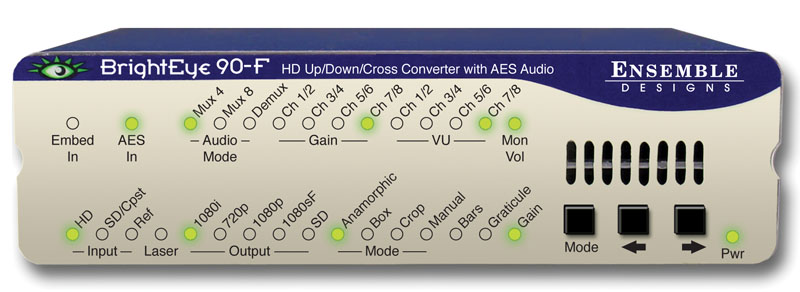
    BrightEye 90-F HD Up/Down Cross Converter and ARC with AES Audio and Optical OutputBrightEye 90-F is a versatile up/down/cross converter or aspect ratio converter for use with analog and digital video signals with the addition of an optical output. Optical connectivity allows for long cable runs between buildings or in mobile applications. Simply set the BrightEye 90-F to output your facility’s preferred HD or SD standard. The BrightEye 90-F will accommodate whatever input you connect analog composite, SD SDI or HD SDI. After setting the output standard, BrightEye 90-F automatically converts the selected input to the correct standard for your facility. BrightEye 90-F will upconvert, downconvert, cross convert, or act as an ARC, as needed. The built-in Frame Synchronizer allows you to feed asynchronous signals to the BrightEye 90-F. An external reference input allows genlock to a house reference. All vertical interval data and closed captioning is faithfully passed. Upconverting to High Definition Feed the analog composite or SD SDI output of a camera to a BrightEye 90-Fand upconvert to HD. You can take the HD signal from the BrightEye 90-F into a switcher or projection system. Upconverting existing SD equipment lets you leverage the equipment you already have and operate in the HD domain. While some cameras may have firewire out, using the video output and upconverting before distribution is preferable since longer cable runs can be achieved and quality is superior. Additionally, the BrightEye 90-F’s reference input allows you to time the upconverted video output for use with a production switcher. Downconverting to Standard Definition BrightEye 90-F will downconvert any type of HD signal and provides both an SD SDI and an analog composite output suitable for broadcast or monitoring. Cross Conversion It’s easy to convert between various HD standards, whether 720p or 1080i. Simply select the output standard you need and connect the input, that’s all there is to it. Aspect Ratio Conversion For converting between SD 4:3 and HD 16:9, BrightEye 90-F has you covered. Just select the output standard you need and connect the input. Audio Processing Made Simple BrightEye 90-F handles both embedded audio and discreet AES digital audio streams. Sixteen channels of embedded audio are supported in BrightEye 90-F. If the incoming video has embedded audio, the audio will be safely bypassed around the video processing and lipsync will be preserved. Audio mixing is available for two of the four embedded groups of audio. The AES I/O ports can be configured for eight channels of incoming audio or for eight channels of audio output. The audio mixer can be used for AES channels as well. Mixer controls are accessed through BrightEye Control Software. Monitoring for Video and Audio Audio monitoring is easy with BrightEye 90-F’s convenient 3.5mm mini jack. Select the audio channels you want to monitor from the front panel and plug in a headset. The HDMI connector on the rear of the unit provides a future proof monitoring interface. Plug it into most LCD monitors for confidence monitoring of your feed. Front Panel and Software Control Input selection, gain control, and test pattern controls are provided through the front panel interface. Audio presence LEDs indicate which channels are detected. Crop, letterbox and pillarbox can all be adjusted from the front panel. For more control, BrightEye Control Software provides controls for proc, audio mixing, and other advanced controls.

    Looking for something else?

    Signal Processing
    I.M.D.P.
    Monitors
    Timing
    Calibration
    Viewfinders

    Contact Sales

    International

    • Plura Europe GmbH Germany
    • Plura MEA Dubai – UAE
    • Plura ASIA Seoul – S. Korea

    The Americas

    • Arizona Plura Broadcast, Inc. HQ

    Stay in touch for news on the latest in product development

    Copyright © 2026 Plura Inc. All Rights Reserved.